Skip to content ↓

📬 Want a dose of MIT in your inbox? Subscribe to the MIT Daily and/or MIT Weekly newsletters.

Top News

Looking for audio? Listen to the MIT News podcast

Recent Highlights

More MIT News articles

In the Media

WBUR

Jeffrey Riley, executive director of MIT RAISE’s “Day of AI” K-12 program, speaks to WBUR’s Suevon Lee about the importance of teaching school-aged children AI literacy skills. “Kids need to know about voice clones and deepfakes and plagiarism,” says Riley. “We need to teach kids so that they're healthy skeptics of this technology, that they mistrust and verify the information they're getting from it.”  

The Washington Post

Prof. Eric Klopfer, co-chair of MIT’s Ad Hoc Committee on AI Use in Teaching, Learning, and Research Training, is spotlighted by The Washington Post’s Susan Svrluga. Klopfer “said in many cases students are turning in homework that is better. And their performance on exams is worse,” writes Svrluga. AI is “the illusion of learning,” says Klopfer.  

Fox Business

Prof. Max Tegmark joins Fox Business's “The Claman Countdown,” to discuss warning lawmakers about the risks of rogue AI at the “Pro-Human Assembly” in Washington. “It’s very obvious that if you make these things [AI] vastly smarter than humans in the next few years, give them robotic bodies, have millions and billions of them all over earth, and don’t understand how they work, we could lose control over them. So, let’s not do that,” says Tegmark. “We have very clear ideas for how we can control AI that cures cancer and [fuels] all sorts of other powerful tools. We want to build tools, not beings that are going to replace us.” 

The Wall Street Journal

In The Wall Street Journal’s “Economics Newsletter,” reporter Greg Ip highlights a study by Prof. David Autor that found that AI did not significantly improve the performance of the 133 patent lawyers who participated. “Among junior lawyers, the performance of some got better, others got worse, and on average they were the same. Among senior lawyers, the lowest performers improved, the best didn’t,” writes Ip. “The conclusion: Lawyers don’t acquire durable new skills with AI.” 

The Wall Street Journal

In an opinion piece for The Wall Street Journal, Gabriele Mazzini, a research affiliate at the MIT Media Lab, explains why “policymakers and voters need to resist AI exceptionalism” amidst recent warnings of a potential AI apocalypse. “There is no sentient [AI] actor lurking in the weights to be reasoned with, feared or pacified,” writes Mazzini. “There are only human software engineers, product managers and corporate boards deciding which guardrails are worth the latency cost and which permissions can be skipped in the race to market.” 

The Boston Globe

The 33-inch original model of the ‘Starship Enterprise,’ from the 1960s “Star Trek” series, will be on display at the MIT Museum from Sept. 30 to March 28, writes reporter Mark Feeney for The Boston Globe. “We are thrilled to have the opportunity to show this unique model,” says MIT Museum Director Michael John Gorman. The model “is not merely a prop; it’s a time capsule of human aspiration.”  

Boston.com

The U.S. News & World Report’s 2027 “Best Colleges Rankings” honors MIT as the No.1 national university, writes Elizabeth Mehler for Boston.com. “The rankings are based on up to 17 weighted measures of academic quality and success, including graduation and retention rates, social mobility for low-income students, post-graduate earnings, academic peer assessment, and faculty resources,” writes Mehler. 

Earth.com

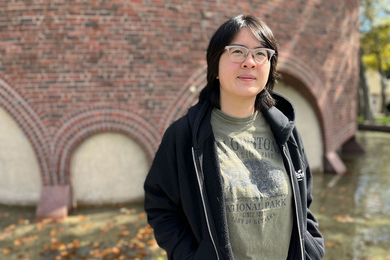
MIT researchers have developed a design tool to highlight the environmental factors that can reduce anxiety, homesickness and boredom during long-duration stays in space, writes Earth.com’s Luis Arrais. “Much like how in our homes the arrangement of our furniture, the size of our rooms, the people we live with, even the shelves we use to store our belongings all contribute to our sense of wellbeing,” says graduate student Mich Lin. 

Forbes

MIT researchers found that AI assisted work leads to the ‘diversity collapse’ of a brand’s voice, and users that rely on AI to do their thinking lose skills over time, highlights Forbes’ Michelle O'Connor. “Judgment, taste and the instinct to catch when something’s off isn’t a soft skill you can afford to lose,” writes O’Connor. “The MIT data is the first hard evidence of that.” 

Quanta Magazine

Quanta Magazine’s Marlowe Starling highlights a 2014 study by MIT researchers that found that coral cilia “interact with the boundary layer by rapidly whipping about to generate swirls of fresh, oxygenated seawater.” The researchers “not only modeled the tiny vortices created by the cilia for the first time, but also revealed the cilia’s importance for survival and metabolism,” notes Starling. 

Community Updates

Featured Multimedia

Video thumbnail

Drawing on research he began at MIT, AJ Perez ’13, MEng ’14, PhD ’23, is finding new uses for the world’s growing plastic waste. His company, Atlas, 3D prints building materials from recycled plastic, giving discarded material a new purpose.

Video thumbnail

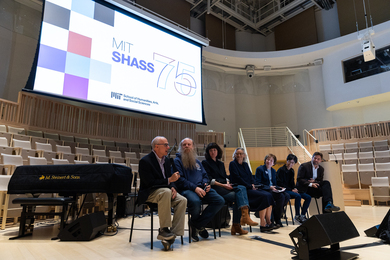
Founded in 1950, MIT’s School of Humanities, Arts, and Social Sciences encourages students to think broadly about the world and their place in it, while examining what it means to be human and the social, ethical, and economic dimensions of today’s greatest challenges.

Video thumbnail

A fast-paced look at the people, ideas, research, and experiences that make MIT what it is. From groundbreaking discoveries and hands-on learning to a vibrant campus community, see the curiosity, creativity, and innovation that drive the Institute. This is MIT.

Video thumbnail

Meet Paula Hammond, MIT Institute Professor and Dean of the School of Engineering—the first woman and first Black scholar to lead MIT's Department of Chemical Engineering. Discover how her pioneering research in nanotechnology and ovarian cancer has shaped her career, the barriers she broke along the way, and what it means to change what leadership looks like in STEM.

Video thumbnail

What if operating an excavator could be faster, easier, and more intuitive? MIT engineers have developed a new controller designed to make digging simpler—and help train operators faster. See how this new technology could change the way we dig.

Video thumbnail

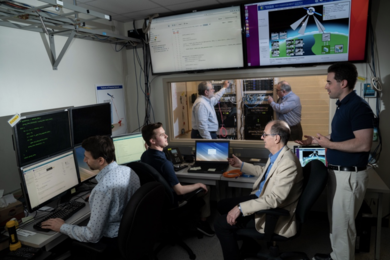
For 75 years, MIT Lincoln Laboratory has developed technology to help keep the nation safe. Founded in 1951, the Laboratory tackles critical national security challenges through long-term research, rapid system prototyping, and demonstration. It also works with industry to transition new concepts and technologies into systems ready for development and deployment.

More News