The 2026 National Football League (NFL) season is well underway, but you won’t find Collin Johnson on the gridiron. After six seasons as a professional football wide receiver, he elected to crisscross the MIT campus as an MBA student at the MIT Sloan School of Management instead.
While in the NFL, Johnson served on the NFL’s Players Association, the union serving players and their families. There, he found his next passion: supporting players’ transition from their playing days to their post-playing lives. Planning his own shift for when he would retire from football, Johnson founded Beyond-Sports, an education platform that develops programs for current and former professional athletes.
“I realized a lot of players struggle for different reasons after they stop playing football,” says Johnson. “It may be financial reasons, or finding community, or finding a new occupation.”
After surveying NFL players about possible career paths, Johnson was surprised to find that “entrepreneurship” was at the top of the list. Intrigued, he decided that his fledgling company needed an entrepreneurship program. His research led him to MIT DesignX, the accelerator program based in the MIT Morningside Academy for Design, and Svafa Grönfeldt and Norbert Chang, the faculty director and lecturer, respectively.
At 10 years old, DesignX has grown from its original program on campus to collaborating with universities and incubation centers around the world, including programs in Italy, France, Dubai, Mexico, Hong Kong, Sweden, and Switzerland. DesignX was recently named by Time magazine as one of the best incubators and accelerators in the United States, ranking highest among design-based programs.
“The field of entrepreneurship is not for the faint of heart, and with the rate of change and the ability to compete, the competition is fiercer than ever,” says Grönfeldt. “At DesignX, we look at how to de-risk the innovation and entrepreneurship process. We take a deep dive into understanding the people we aim to serve with what we create. What are their pain points, what are their needs, and what does any solution have to actually fulfill those needs or address those pain points? That is where the tools of design come in.”
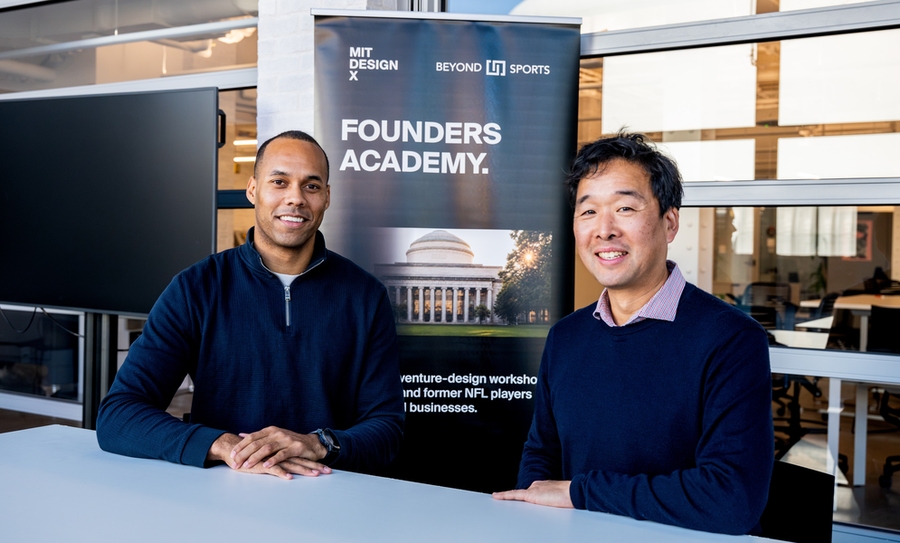
Chang, who took the lead on developing the program with Johnson, says he found Johnson to be mission-driven, in large part because Johnson had just left pro football and was experiencing the transition himself.
“He knew firsthand what it feels like to step away from the game and ask yourself, ‘What’s next?’” says Chang. “He also knew how few resources exist to help athletes answer that question in a serious way. That lived experience shaped everything about the program.”
The result is Founders Academy, a venture-building executive education program designed to help current and former NFL players bring their ideas to life. The cornerstone of the program — a four-day workshop at MIT — was held earlier this summer.
Undaunted by hard work
“Building this program together meant taking the curriculum DesignX normally runs over a semester and condensing it into four days, while keeping its rigor,” says Chang. “That was highly ambitious, and Collin still pushed for more. He was the athletes’ biggest believer.”
Johnson says he recognized the similar mindsets between athletes and entrepreneurs.
“There is a constant feedback loop that players are exposed to nearly every day,” he says. “We practice and then watch film to see how and where we can improve. We get obsessed with our craft and we iterate and do it again the next day and try to improve. We have agency over our craft — much like entrepreneurs.”
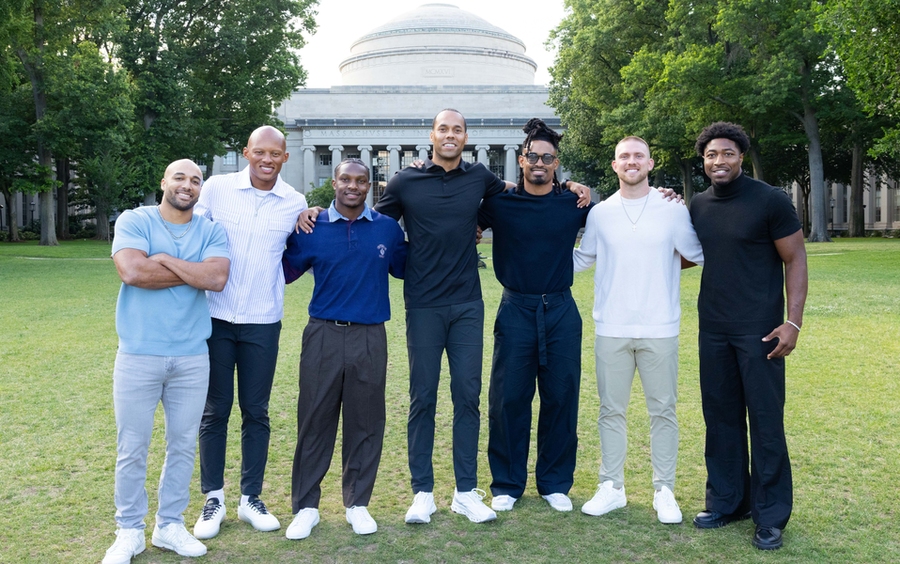
If the metaphor that the rigors of an MIT education is akin to drinking from a fire hose causes some to hesitate, it did not faze the six current and former professional football players who attended the inaugural program. Grönfeldt says she was delighted with the passion and rigor they brought to the program, and she learned a lot about the life of a football player.
“We only see the glamour side of their life, but to hear them talk about the mental work, determination, and the stamina required is impressive,” she says. “DesignX goes through rapid prototyping, and the process goes very fast. They’re used to speed and not being in their comfort zone. They took to the material, sat down at eight o’clock in the morning, and they were still going at it at 10 o’clock at night. They had an impressive work ethic.”
Been there, done that
Because the DesignX curriculum was condensed and originally not designed for solo entrepreneurial efforts, Chang added a mentorship component to the program. Each student was paired with a mentor who had been through the experience and had tangible experience in their industry.
“That meant someone who could guide them, pressure-test their thinking, and share hard-won lessons from building companies themselves,” says Chang. “Mentors were also able to open doors and make connections to help accelerate their ventures.”
Johnson did not want to develop a feel-good program for the athletes. He wanted them to see what entrepreneurship actually involves, from defining the problem to building the product to learning the economics of fundraising — including the hard, unglamorous parts. Applicants were required to share a business interest and proposed solution or an existing business they planned to develop. Applications were reviewed by Johnson and DesignX faculty to determine readiness and to match mentors — sourced heavily through Grönfeldt’s and Chang’s networks — with each venture.
“I found the athletes’ business ideas to be directly related to the curriculum that was taught,” says Johnson. “That was the game changer for them, because they could talk directly with Norbert and Svafa about their ideas. The curriculum really unlocked everything for them.”
To launch the academy shortly before beginning his own journey at MIT Sloan was a huge thrill for Johnson. Making it more rewarding were the rave reviews from the participants. That feedback has given Johnson a path to refining next year’s program with Grönfeldt and Chang. He has already procured Founders Academy as an approved program by the NFL Players Association, which allows future applicants to attend the program with little to no out-of-pocket cost. Participants earn a DesignX certificate when they complete the program.
“Ultimately, I’d like to integrate the mentorship model into MIT’s ecosystem,” says Johnson. “I can see a time when MIT students are serving as mentors to the athletes. It could be a mutually beneficial collaboration. When you think about an MIT doctoral student and an NFL player, at face value, you don’t think they have anything in common. But when they sit down and bond over a problem — we found they have a lot in common.”