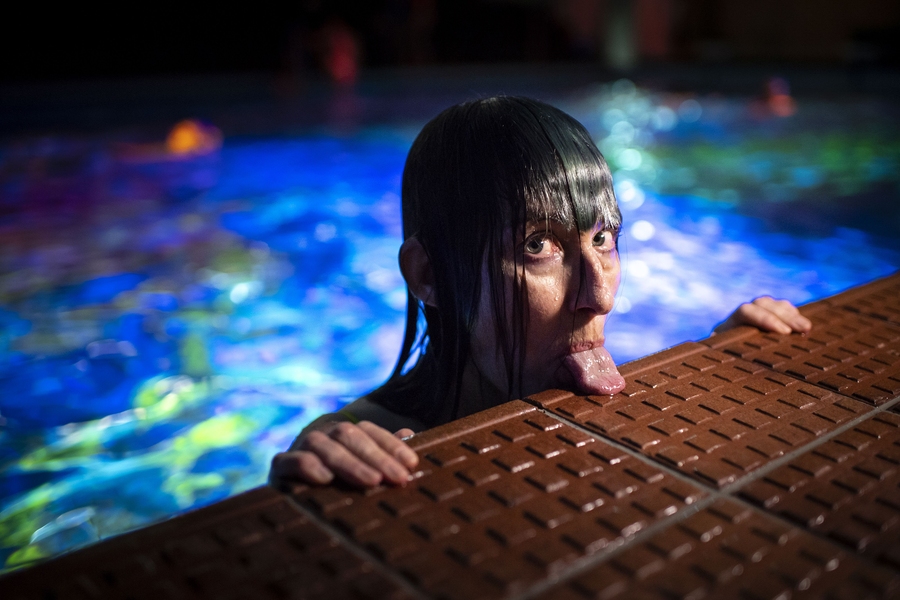
Artist Pipilotti Rist is the recipient of the 2027 Eugene McDermott Award in the Arts at MIT, which will be awarded at her MIT public presentation on April 8, 2027, and includes an artist residency at MIT in spring 2027.
Rist is a pioneer of spatial video art whose work explores the deep connections between the human body, nature, technology, and sensory perception using immersive video and light installations.
Rist said upon receiving the award, “I am kissing your Institute and your feet. I am immensely touched and grateful to have this trust and investment in ideas I’ve yet to conceive. I’m honored to receive an award that has been granted to so many of my heroes, and look forward to collaborating closely with the brilliant minds at MIT.”
The Eugene McDermott Award in the Arts at MIT recognizes innovative artists working in any field or cross-disciplinary activity. The prize represents an investment in the recipient’s future creative work, rather than a particular project or lifetime of achievement.
The official announcement was made at the Council for the Arts at MIT’s 52nd annual meeting at MIT in October. Past recipients include Santiago Calatrava, Es Devlin, Gustavo Dudamel, Olafur Eliasson, Robert Lepage, Audra McDonald, Suzan-Lori Parks, Bill Viola, and Pamela Z, among others.
MIT Vice Provost for the Arts Keeril Makan says, “Pipilotti Rist has spent four decades using digital tools to dissolve the line between screen, body, building, and landscape. Her immersive multimedia installations slow us down, return us to our bodies and the spaces we occupy, and gather us into shared experience, rather than fragmenting our attention. We look forward to presenting Pipilotti Rist with MIT’s highest award in the arts, and it comes at an exciting moment as we gather our students and faculty to activate our new building for the School of Architecture and Planning, the MET Warehouse.”
A distinctive feature of the award is a short residency at MIT, which includes a public presentation of the artist’s work, as well as substantial interaction with students and faculty. The goal of the residency is to provide the recipient with unparalleled access to the creative energy and cutting-edge research at the Institute and to develop mutually enlightening relationships in the MIT community.
The Eugene McDermott Award in the Arts at MIT was established in 1974 by Margaret McDermott (1912–2018) in honor of her husband, Eugene McDermott (1899–1973), a co-founder of Texas Instruments and long-time friend and benefactor of MIT. The award is presented by the Council for the Arts at MIT, a volunteer group of alumni and friends, fulfilling their mission “to foster the arts at MIT and to act as a catalyst for the development of a broadly based, highly participatory program in the arts.”
The award is bestowed upon individuals whose artistic trajectory and body of work have achieved the highest distinction in their field and indicate they will remain leaders for years to come. The award recognizes innovative talents in any arts discipline, and, thanks to the McDermott family gift, offers its recipient a $100,000 cash prize and a campus residency. The McDermott Award reflects MIT’s commitment to risk-taking, problem-solving, and connecting creative minds across disciplines. Since it was established in 1974, the award has been bestowed upon 40 individuals who work in performing, visual, literary, and media arts.

Pipilotti Rist, a pioneer of spatial video art, was born 1962 in Grabs in the Swiss Rhine Valley on the Austrian border and has been a central figure within the international art scene since the mid-1980s. Astounding the art world with the energetic exorcistic statement of her now-famous single-channel videos, such as “I’m Not The Girl Who Misses Much” (1986) and “Pickelporno” (1992), her artistic work has co-developed with technical advancements and in playful exploration of its new possibilities to propose footage resembling a collective brain. Through large video projections and digital manipulation, she has developed immersive installations that draw life from slow caressing showers of vivid color tones, like her works “Sip My Ocean” (1996) or “Worry Will Vanish” (2014).
For Rist, showing vulnerability is a sign of strength on which she draws for inspiration. With her curious and lavish recordings of nature (to which humans belong as an animal), and her investigative editing, Rist seeks to justify the privileged position we are born with, simply by being human. Her installations and exhibition concepts are expansive, finding within the mind, senses, and body the possibility for endless discovery and poetical invention. “Pixel Forest” (2016), made from 3,000 LEDs hung on strings, resembles a movie screen that has exploded into the room, allowing viewers an immersive walk through three-dimensional video. As she herself puts it, “beside the energy-intensive exploration of the geographical world, pictures, films and sounds have been and are the spaces into which we can escape ... The projector is the flamethrower, the space is the vortex, and you are the pearl within.”
Since 1984, Rist has had countless solo and group exhibitions, and video screenings worldwide. Her recent solo exhibitions are “Your Palm is My Universe” at UCCA Beijing (2025), “Electric Idyll” at the Fire Station Doha (2024), “Prickling Goosebumps & A Humming Horizon” at Hauser & Wirth New York and Luhring Augustine Chelsea (2023-24), “Behind Your Eyelid” at Tai Kwun Hong Kong (2022), “Big Heartedness, Be My Neighbor” at The Geffen Contemporary, MOCA, Museum of Contemporary Art Los Angeles (2021–22), and “Your Eye Is My Island” at MoMAK, The National Museum of Modern Art Kyoto and ART TOWER MITO (2021). “Åbn min Lysning. Open my Glade” at Louisiana Museum of Modern Art Humlebæk Denmark (2019), “Sip My Ocean” at the Museum of Contemporary Art Sydney (2017–18), “Pixel Forest” at New Museum New York (2016–17), and “Your Saliva is My Diving Suit of the Ocean of Pain” at Kunsthaus Zürich (2016) all resulted in record-breaking attendance for each institution.