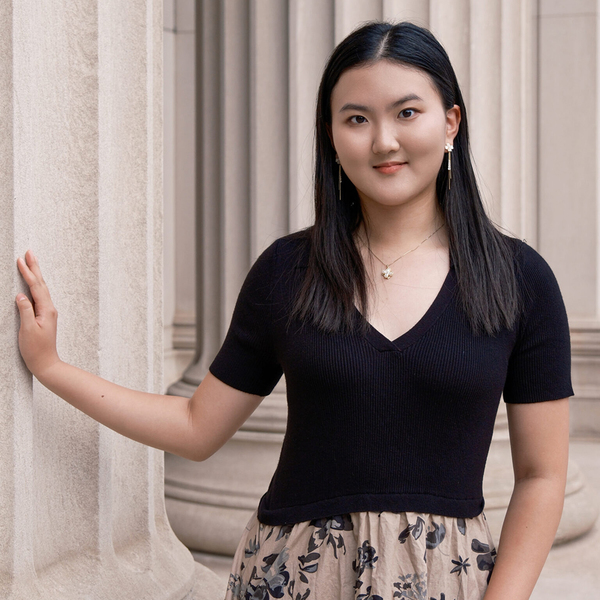
Stephanie Han is pursuing a very complex course of study at MIT — even for MIT. A double-major in computer science, economics, and data science (Course 6-14) and finance (Course 15-3), she is also minoring in public policy, which involves additional classes in economics, political science, and urban studies and planning.
Now a senior, and an associate advisor for the Undergraduate Advising Center (UAC), Han helps her fellow undergraduates navigate their own academic paths through MIT. She works with first-year students to help them decide which classes to take, and she helps them come up with a plan for their academic experience at MIT. Just as important, Han says, is encouraging students to ask themselves questions, take risks, and remain open to new discoveries as they find the road through college that’s right for them.
Q: How did you end up with such a complicated course of study?
A: I was interested in economics in high school, and I also did a lot of debate, which felt like a political science and public policy path. I got interested in finance after learning more about economics and seeing that finance is a pretty good application of a lot of economics concepts.
One class that really affected me was Taxes and Business Strategy. No one ever believes me when I say that — but it was absolutely amazing! I loved the professor, and I would go to office hours to talk to him about the concepts. He was always very passionate about it.
I also talked to upper-level students and to people from all the departments. Also just meeting people — in my dorm, or classes, or social settings, or just random places. If I heard someone talking about majoring in 15-3 or 6-14, I would ask about it. People are always willing to give advice.
Q: How would you describe your work for the UAC?
A: When students have questions about what classes to take, I can give them a student's perspective. It might be more detailed than what staff or faculty advisors have to say because I've experienced the classes firsthand.
Giving students confidence about the schedule they're assembling is key, and making sure it complements the path they're preparing for. It's asking them — “Is this right? Will this be OK when you’re deciding classes two years in the future?” Because if you get there and didn’t take the classes you were supposed to take, it can be a real challenge.
But the great thing about advising is the personal connections. I like going in person and just talking face to face with my own advisors and professors, and I really like talking to the people I advise. Seeing how each of them approaches things is fascinating. Some come in with an idea of the perfect first-year schedule, and others don't know what they want. With each person I work with, it's a unique experience.
Q: Is there general advice you give students about their first year?
A: I tell them to enjoy the “pass/no-record” grading option. This is one thing I should have done more — not focus so much on getting the A. In my first semester, I maybe wish I’d spent time exploring student clubs or going out into the city.
I also sometimes tell them I failed a class. MIT was, at least for me, really different from high school. I struggled. Failing linear algebra was devastating at the time, but afterwards I realized it wasn't that big of a big deal — so I failed a class. I'm going to retake it and move on. I learned a lot about what I needed to work harder on and how to ask for help.
Q: Do students show up already decided on a major, or pick one after they get here?
A: There's a pretty good mix, but I think most people come in with a sense of direction. I rarely get someone who has completely no idea. But I've had friends who changed their majors multiple times. After taking classes, you learn more about the major, and sometimes you just can't see yourself in it as a career.
Either way, I always recommend taking the General Institute Requirements early, because you need them even if you switch majors. If someone is already set on a major, they might be more inclined to start early on their classes in their major. That’s fine. Nothing is set in stone.
If somebody's trying to choose between majors, I tell them to take a couple classes in both, and to talk to professors and upper-level students in the department. Sometimes during those conversations, they realize they love it — or they realize the opposite.
Q: What other kinds of advice do you give students?
A: The first-year transition comes with a lot of pressure — adapting to being away from home, and having to decide on a major that might affect your whole future, and all that. I tell them not to be afraid to ask for help — go to office hours, talk to your TAs [teaching assistants], go to recitations. These are great ways to just get practice in the ideas of the class.
It takes effort, like activation energy, and a bit of courage. I've emailed professors to say I couldn’t make it to their office hours, and they all said, yes, of course, I'll make time. It's scary to email a professor directly! I felt intimidated, as a freshman, just cold emailing. But faculty are more than happy to meet with their students. It helps for first-years to hear that.
Q: What about when your advice conflicts with someone else’s?
A: I might ask, “What are your thoughts?” I want to see their perspective. And if they're already swayed in that direction, it’s good to give them the other perspective. I might say, “That’s a good point. Here's another option.”
Parents have a lot of influence. I talk to my parents a lot, and if they give me advice, I will definitely be more inclined to follow it. My dad is an electrical engineering professor at Michigan State University, and my mom is an accountant, but she was actually a chemical engineer before she switched. I think that that's what makes her so supportive of me trying out a lot of different things. I've never wanted to go into either of their professions. I always wanted to do something different.
Q: What’s the best advice you ever got?
A: Go try everything. If you see a class you like, even one that doesn't fit in your major — go take it. You might discover something new.
I added my public policy minor after I took Making Public Policy. I had already finished my communication requirements so I didn’t really need it, but I just wanted to take it — and now it's my minor. Last year, I took patent law because I just thought it would be cool, and this year I'm going to take something on AI and the law. The topic is interesting, and I like the professor.
Even now, when I’m advising and I learn about new classes, I’m often like, “Wow! I wish I knew this my freshman year — I would have taken this class!”