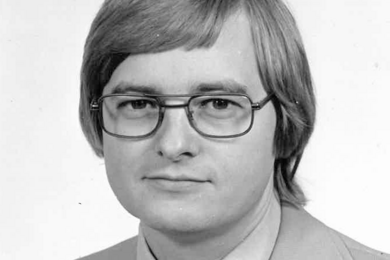

Robert Liebeck, a professor of the practice in the MIT Department of Aeronautics and Astronautics and one of the world’s leading experts on aircraft design, aerodynamics, and hydrodynamics, died on Jan. 12 at age 87.
“Bob was a mentor and dear friend to so many faculty, alumni, and researchers at AeroAstro over the course of 25 years,” says Julie Shah, department head and the H.N. Slater Professor of Aeronautics and Astronautics at MIT. “He’ll be deeply missed by all who were fortunate enough to know him.”
Liebeck’s long and distinguished career in aerospace engineering included a number of foundational contributions to aerodynamics and aircraft design, beginning with his graduate research into high-lift airfoils. His novel designs came to be known as “Liebeck airfoils” and are used primarily for high-altitude reconnaissance airplanes; Liebeck airfoils have also been adapted for use in Formula One racing cars, racing sailboats, and even a flying replica of a giant pterosaur.
He was perhaps best known for his groundbreaking work on blended wing body (BWB) aircraft. He oversaw the BWB project at Boeing during his celebrated five-decade tenure at the company, working closely with NASA on the X-48 experimental aircraft. After retiring as senior technical fellow at Boeing in 2020, Liebeck remained active in BWB research. He served as technical advisor at BWB startup JetZero, which is aiming to build a more fuel-efficient aircraft for both military and commercial use and has set a target date of 2027 for its demonstration flight.
Liebeck was appointed a professor of the practice at MIT in 2000, and taught classes on aircraft design and aerodynamics.
“Bob contributed to the department both in aircraft capstones and also in advising students and mentoring faculty, including myself,” says John Hansman, the T. Wilson Professor of Aeronautics and Astronautics. “In addition to aviation, Bob was very significant in car racing and developed the downforce wing and flap system which has become standard on F1, IndyCar, and NASCAR cars.”
He was a major contributor to the Silent Aircraft Project, a collaboration between MIT and Cambridge University led by Dame Ann Dowling. Liebeck also worked closely with Professor Woody Hoburg ’08 and his research group, advising on students’ research into efficient methods for designing aerospace vehicles. Before Hoburg was accepted into the NASA astronaut corps in 2017, the group produced an open-source Python package, GPkit, for geometric programming, which was used to design a five-day endurance unmanned aerial vehicle for the U.S. Air Force.
“Bob was universally respected in aviation and he was a good friend to the department,” remembers Professor Ed Greitzer.
Liebeck was an AIAA honorary fellow and Boeing senior technical fellow, as well as a member of the National Academy of Engineering, Royal Aeronautical Society, and Academy of Model Aeronautics. He was a recipient of the Guggenheim Medal and ASME Spirit of St. Louis Medal, among many other awards, and was inducted into the International Air and Space Hall of Fame.
An avid runner and motorcyclist, Liebeck is remembered by friends and colleagues for his adventurous nature and generosity of spirit. Throughout a career punctuated by honors and achievements, Liebeck found his greatest satisfaction in teaching. In addition to his role at MIT, he was an adjunct faculty member at University of California at Irving and served as faculty member for that university’s Design/Build/Fly and Human-Powered Airplane teams.
“It is the one job where I feel I have done some good — even after a bad lecture,” he told AeroAstro Magazine in 2007. “I have decided that I am finally beginning to understand aeronautical engineering, and I want to share that understanding with our youth.”