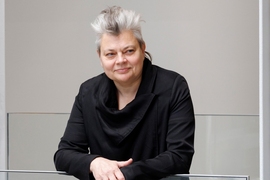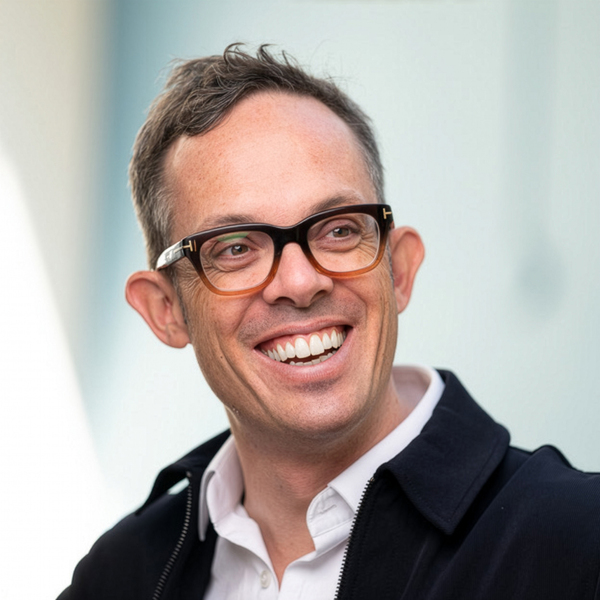
When Nicholas de Monchaux became head of the Department of Architecture at the School of Architecture and Planning (SA+P) in 2020, he stepped into an unusual set of leadership conditions. He had been due to start in July 2020. Instead, a springtime visit to Cambridge, Massachusetts, coincided with the first Covid-19 lockdowns, and he found himself taking on the role earlier than planned — several months before faculty, students, and staff were able to gather in the same room.
As he concludes his tenure as head of the department before becoming dean of the University of California at Berkeley’s College of Environmental Design, de Monchaux reflects on a period of disruption that became an opportunity to strengthen the department’s infrastructure and advance new models for architectural education and research: “One of the key accomplishments of my time as head of the department has involved finding ways to teach one of MIT’s most physical and collaborative subjects remotely, while keeping the community together and rebuilding our studio culture once we were back on campus,” he says.
Engaging complexity
The questions that have motivated de Monchaux’s research became central to the challenge of leading the department. As an architect and design theorist, his work draws on the science of adaptive complex systems to examine how design can shape resilient forms of organization under changing conditions.
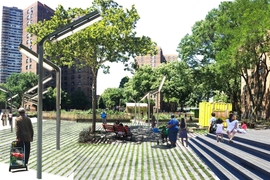
His first book, “Spacesuit: Fashioning Apollo,” argues that the design of the Apollo spacesuit succeeded through continual adaptation across materials, manufacturing practices, and institutional networks, rather than through engineering optimization alone. His subsequent book, “Local Code: 3,659 Proposals About Data, Design, and the Nature of Cities,” shifts this inquiry from the body to the city, using geospatial data to show how thousands of marginal city-owned vacant lots could collectively support new forms of ecological and civic infrastructure, replacing top-down master planning with coordinated, site-specific interventions. If the impacts of the pandemic could be characterized as an emergent complex system at the scale of the body, the city, the planet — then leadership could be framed as a design problem.
De Monchaux’s understanding of design in relation to complexity science is influenced by his long-standing engagement with the Santa Fe Institute, where he serves as external faculty alongside researchers in the natural sciences, social sciences, and humanities. His instinct for combining multiple forms of knowledge can be traced back to MIT — he spent formative years here, where his father, John de Monchaux, served as dean of SA+P from 1981 to 1992. “I was shaped by the ethos of curiosity at MIT,” he says. “Not just when it comes to questions of science and technology, but also those of art, design, and culture.”
Paradox and works in progress
That way of thinking becomes especially relevant in the context of climate change. According to the U.N. Environment Program, the construction and operation of buildings account for almost 40 percent of global greenhouse gas emissions, an even larger share when urbanization, transportation, and the wider built environment are taken into account. For architects, this presents a paradox: The systems they work within have contributed substantially to the problems they now seek to solve.
“Over the past six years, our department has focused on two fundamental climate-related challenges,” says de Monchaux. “One is how to build differently through new approaches to circularity and material reuse. The other is how to make our social, cultural, and physical systems more resilient.”
Those priorities find expression in the Climate Studios, a research and teaching initiative nestled under the Option Studios (course number 4.154) that brings together faculty members — including architects, engineers, and historians — to collaborate with students on impact-driven research projects related to climate across multiple years of integrated research and pedagogy.
“The studios reorganize teaching in the department because students aren’t just working on speculative exercises, they’re working on real issues,” says de Monchaux. “Likewise, the studios reorganize research by allowing faculty to benefit from the boundless energy and imagination of our design students.”
The Climate Studios are part of a wider constellation of climate action initiatives in collaboration with the MIT Department of Urban Studies and Planning (DUSP). One example is a collaboration with DUSP and outgoing Department Head Chris Zegras, toward creating an MIT Civilian Climate Corps. Including seminars and workshops on community-focused design for MIT and its neighbors, and student-staffed work on circular material use, the initiative served as an incubator for the MIT Farm. Other projects at different stages of development were presented in the exhibition “Climate Work: Un/Worlding the Planet,” the department’s exhibition at the 2025 Venice Architecture Biennale, curated by de Monchaux alongside incoming department head Ana Miljački and exhibition designer Calvin Zhong ’18, MA ’24, MCP ’24. The exhibition embodied its own principles of circularity: The modular display tables, fabricated in Venice, were designed for reuse, and have since been installed as worktables in the department’s forthcoming home, the Metropolitan Storage Warehouse (the Met) — a space designed, like the exhibition, to invite continual experimentation.
Building connections
The transformation of the Met has provided another opportunity for de Monchaux to think about architecture as a process of adaptation and collaboration. Having previously worked at Diller Scofidio + Renfro, the architecture firm engaged for the renovation project, he brought a unique perspective to the process, acting as “a translator between two different languages.” Recognizing the shared culture of experimentation that linked the architecture firm and the department, he advocated for a more radical approach to the renovation, pushing the boundaries of what might be expected from an institutional building.
“It was important that the building remain open-ended and a little raw, because there’s a long tradition at MIT of students and faculty shaping their own studios and spaces,” he explains.
While de Monchaux is proud of the initiatives that took shape during his tenure, as a scholar of complex systems he knows better than to claim ownership over any single project. He describes both architecture and administration as acts of organization and rearrangement, evolving the work of predecessors and making way for those who follow.
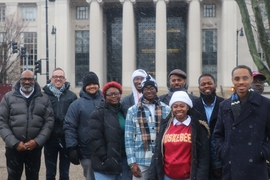
One of the clearest examples is the department’s collaboration with Tuskegee University, which will be carried forward by Miljački. The Robert R. Taylor Project builds on a relationship dating back to 1893, when MIT’s first Black graduate and the nation’s first professionally trained Black architect left Cambridge to design much of Tuskegee’s campus, playing an influential role in defining the university’s approach to architectural education. De Monchaux worked closely with Kwesi Daniels, head of architecture at Tuskegee, to establish an exchange program connecting students and faculty through complementary forms of expertise, from the study of historic preservation at Tuskegee to digital fabrication and entrepreneurship at MIT.
“A relationship that was purely symbolic has now become part of the fabric of the two institutions, expanding access to different programs and ways of teaching,” says de Monchaux.
Invisible infrastructure
Less visible, but equally consequential, is the impact of strengthening the department’s underlying social and physical infrastructure. During de Monchaux’s tenure, this has included expanding student governance and community forums, increasing minimum fellowship support for MArch graduate students from 50 to 90 percent of tuition, earning accreditation for the department’s professional degree in architecture, and ensuring that every MArch student has access to a department-provided workstation in studio.
“What we’re really talking about is unlocking the latent curiosity and passion of every person in the department, providing the infrastructure that allows them to accomplish what they wouldn’t be able to do otherwise,” says de Monchaux.
That statement resonates with an idea he put forth in a 2023 essay for MIT Technology Review, which argued for a return to the roots of the word “design.” Successful designers, he proposed, “reshape not just objects, but also the culture and institutions that create them.” And so, if leadership is a design problem, the goal is to create the conditions for continually new and productive outcomes. The infrastructures built during this period — physical, academic, and social — provide a strong foundation for the leadership of de Monchaux’s colleague and successor, “the incredibly capable and visionary Ana Miljački.”