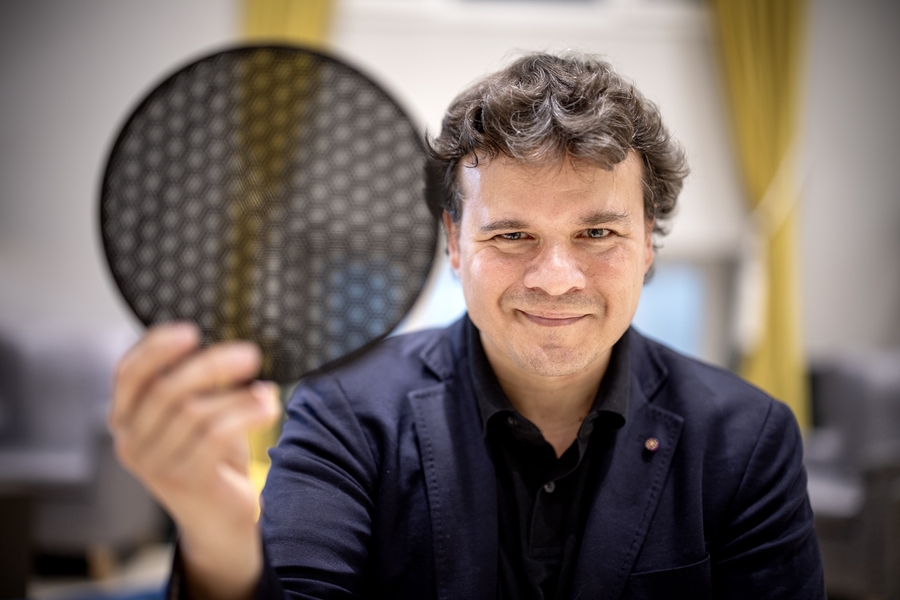
Pablo Jarillo-Herrero, the Cecil and Ida Green Professor of Physics at MIT, has won the 2025 BBVA Foundation Frontiers of Knowledge Award in Basic Sciences for “discoveries concerning the ‘magic angle’ that allows the behavior of new materials to be transformed and controlled.”
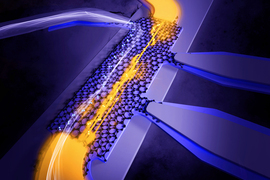
He shares the 400,000-euro award with Allan MacDonald of the University of Texas at Austin. According to the BBVA Foundation, “the pioneering work of the two physicists has achieved both the theoretical foundation and experimental validation of a new field where superconductivity, magnetism, and other properties can be obtained by rotating new two-dimensional materials like graphene.” Graphene is a single layer of carbon atoms arranged in hexagons resembling a honeycomb structure.
Theoretical foundation, experimental validation
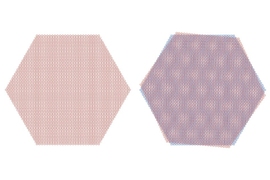
In a theoretical model published in 2011, MacDonald predicted that on twisting two graphene layers at a given angle, of around 1 degree, the interaction of electrons would produce new emerging properties.
In 2018, Jarillo-Herrero delivered the experimental confirmation of this “magic angle” by rotating two graphene sheets in a way that transformed the material’s behavior, giving rise to new properties like superconductivity.
The physicists’ work “has opened up new frontiers in physics by demonstrating that rotating matter to a given angle allows us to control its behavior, obtaining properties that could have a major industrial impact,” explained award committee member María José García Borge, a research professor at the Institute for the Structure of Matter. “Superconductivity, for example, could bring about far more sustainable electricity transmission, with virtually no energy loss.”
Almost science fiction
MacDonald’s initial discovery had little immediate impact. It was not until some years later, when it was confirmed in the laboratory by Jarillo-Herrero, that its true importance was revealed.
“The community would never have been so interested in my subject, if there hadn’t been an experimental program that realized that original vision,” observes MacDonald, who refers to his co-laureate’s achievement as “almost science fiction.”
Jarillo-Herrero had been intrigued by the possible effects of placing two graphene sheets on top of each other with a precise rotational alignment, because “it was uncharted territory, beyond the reach of the physics of the past, so was bound to produce some interesting results.”
But the scientist was still unsure of how to make it work in the lab. For years, he had been stacking together layers of the super-thin material, but without being able to specify the angle between them. Finally, he devised a way to do so, making the angle smaller and smaller until he got to the “magic” angle of 1.1 degrees at which the graphene revealed some extraordinary behavior.
“It was a big surprise, because the technique we used, though conceptually straightforward, was hard to pull off in the lab,” says Jarillo-Herrero, who is also affiliated with the Materials Research Laboratory.
Since 2009, the BBVA has given Frontiers of Knowledge Awards to more than a dozen MIT faculty members. The Frontiers of Knowledge Awards, spanning eight prize categories, recognize world-class research and cultural creation and aim to celebrate and promote the value of knowledge as a global public good. The BBVA Foundation works to support scientific research and cultural creation, disseminate knowledge and culture, and recognize talent and innovation.