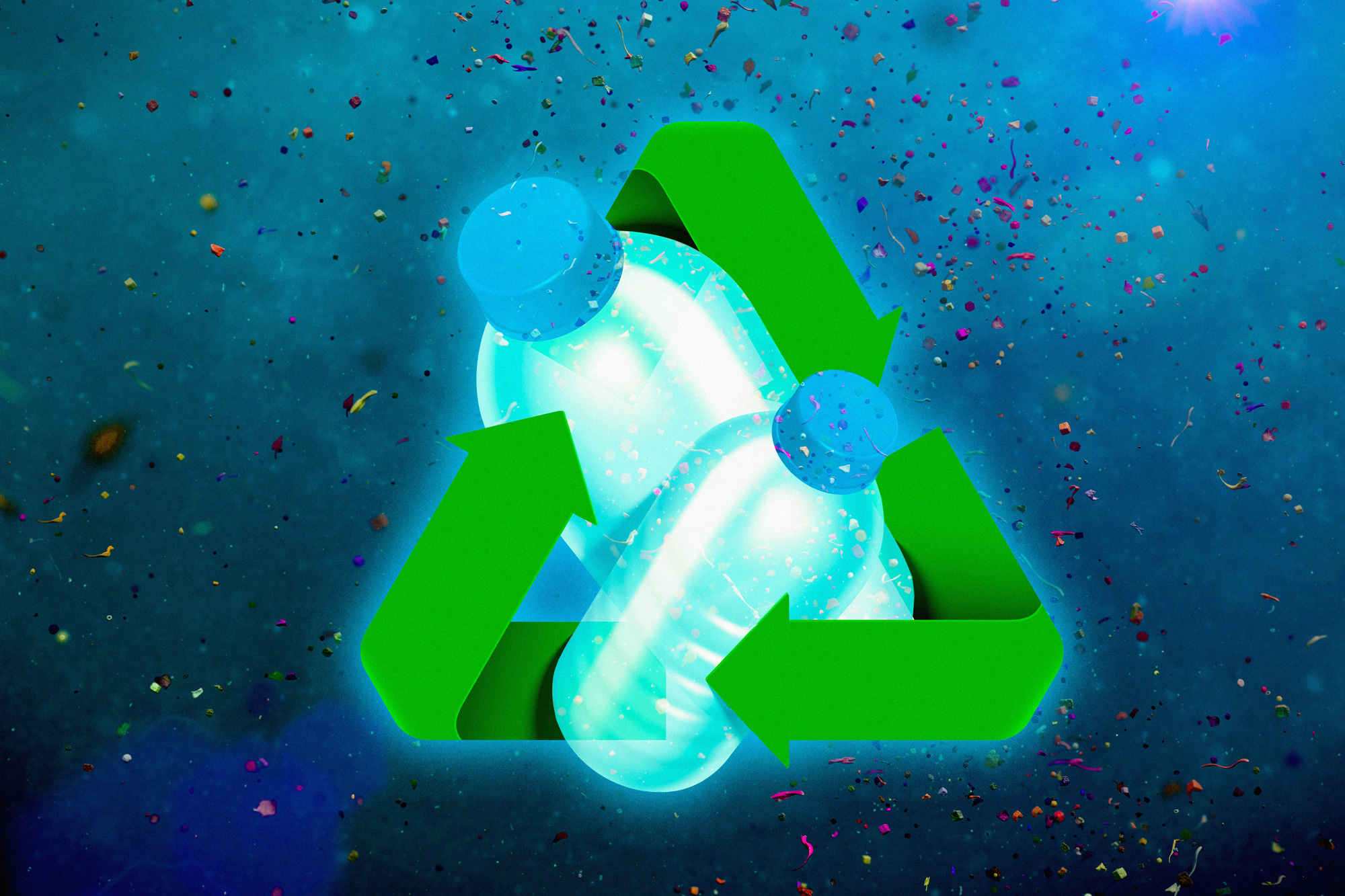
Biodegradable plastics could help alleviate the plastic waste crisis that is polluting the environment and harming our health. But how long plastics take to degrade and how environmental bacteria work together to break them down is still largely unknown.
Understanding how plastics are broken down by microbes could help scientists create more sustainable materials and even new microbial recycling systems that convert plastic waste into useful materials.
Now MIT researchers have taken an important first step toward understanding how bacteria work together to break down plastic. In a new paper, the researchers uncovered the role of individual ocean bacteria in the breakdown of a widely used biodegradable plastic. They also showed the complementary processes microbes use to fully consume the plastic, with one microbe cleaving the plastic into its component chemicals and others consuming each chemical.
The researchers say it’s one of the first studies illuminating specific bacterial species’ role in the breakdown of plastic and indicates the speed of plastic degradation can vary widely depending on a few key factors.
“There is a lot of ambiguity about how long these materials actually exist in the environment,” says lead author Marc Foster, a PhD student in the MIT-WHOI Joint Program. “This shows plastic biodegradation is highly dependent on the microbial community where the plastic ends up. It’s also dependent on the plastics — the chemistry of the polymer and how they’re made as a product. It’s important to understand these processes because we’re trying to constrain the environmental lifetime of these materials.”
Joining Foster on the paper are MIT PhD candidate Philip Wasson; former MIT postdoc Andreas Sichert; MIT undergraduate Deborah Madden; Woods Hole Oceanographic Institute researchers Matthew Hayden and Adam Subhas; Chong Becker and Sebastian Gross of the international chemical and plastic company BASF; Otto Cordero, an MIT associate professor of civil and environmental engineering; Darcy McRose, MIT’s Thomas D. and Virginia W. Cabot Career Development Professor; and Desirée Plata, MIT’s School of Engineering Distinguished Climate and Energy Professor. The paper appears in the journal Environmental Science and Technology.
Uncovering collaboration
Scientists hope biodegradable plastic can be used to address the mountains of plastic waste piling up in our oceans and landfills.
“More than half of produced plastic is either sent to landfills or directly released into the environment,” Foster says. “But without knowing the specifics of different degradation processes, we won’t be able to accurately predict the lifetime of these materials and better control that degradation.”
To date, many studies into the biodegradation of plastics have focused on single microbial organisms, but Foster says that’s not representative of how most plastics are broken down in the environment.
“It’s really rare for a single bacterium to carry out the full degradation process because it requires a significant metabolic burden to carry all of the enzymatic functions to depolymerize the polymer and then use those chemical subunits as a carbon and energy source,” Foster says.
Other studies have sought to capture the molecular footprints of groups of bacteria as they degrade plastic, which gives a snapshot of the species involved without uncovering the mechanisms of action.
For this study, the researchers wanted to uncover the roles of specific bacterial species as they fully degraded plastic. They started with a type of biodegradable plastic known as an aromatic aliphatic co-polyester. Such plastic is used in shopping bags and food packaging. It’s also often laid across the soil of farms to prevent weeds and retain moisture.
To begin the study, researchers at BASF, which produces that type of plastic, first placed samples of the product into different depths of the Mediterranean Sea to let bacteria grow as a thin biofilm around the plastic. The company then shipped the samples to researchers at MIT, who isolated as many species of bacteria as possible from the samples. The researchers mixed those isolates and identified 30 bacterial species that continued to grow in abundance on the plastic.
Using carbon dioxide as a measure of plastic degradation, the researchers isolated each bacterium and found one, Pseudomonas pachastrellae, that could depolymerize the plastic compounds, breaking them into the three chemical components of the plastic: terephthalic acid, sebacic acid, and butanediol.
But that bacterium couldn’t consume all three components on its own. One by one, the researchers exposed each bacterium to each chemical, finding no bacteria that could consume all three, although they did find some species that could consume one or two chemicals on their own.
Finally, the researchers selected five bacterial species based on their complementary breakdown abilities and showed the small group exhibited the same ability to fully degrade the plastic as the 30-member bacteria community.
“I was able to minimize the degradation process to this simplistic set of specific metabolic functions,” Foster says. “And then when I took out one bacterium, the mineralization dropped, which indicated the organism was controlling the degradation of the polymer. Then when I had each one of the bacteria alone in a culture, none of them could reach the same degradation as all five together, indicating there was this complementary function required. It worked much better than I thought it would.”
The researchers also found the five-member bacteria community couldn’t mineralize a different plastic, showing groups of bacteria may only be able to mineralize specific plastics.
“It highlights that the microbes living where this plastic ends up are going to dictate the plastic’s lifetime,” Foster says.
Faster plastic degradation
Foster notes the bacteria in his study are likely specific to the Mediterranean Sea. The study also only involved bacteria that could survive in his lab environment. Still, Foster says it’s one of the first papers that identifies the roles of bacteria in consuming plastic.
“Most studies wouldn’t be able to identify the specific bacteria that’s controlling each complementary mineralization process,” Foster says. “Here we can say this bacteria controls degradation, these bacteria handle mineralization, and then we show the function of each bacteria and show that together, they can remove the entire polymer.”
Foster says the work is an important first step toward creating microbial systems that are better at breaking down plastic or converting it into something useful. In follow-up work for his PhD, he is exploring what makes successful bacterial pairs for faster plastic consumption and how enzymes dock on plastic particles to initiate and continue degradation.
The work was supported by the MIT Climate and Sustainability Consortium and BASF SE. Partial support was provided by the U.S. National Science Foundation Graduate Research Fellowship Program.