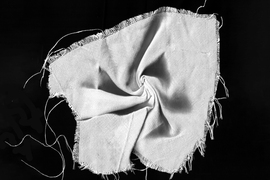
After a closet cleanout, what options are there for recyling our old threads? Not many. Apart from bringing used clothes to a donation center, there is no process for recycling textiles like there is for bottles and cans. And, the average American throws out around 81 pounds of clothing each year. That amounts to more than 11 million tons of textiles that end up in the landfill or incinerator.
But MIT engineers hope to cut down on the growing mountain of textile waste, with a new, recyclable yarn.
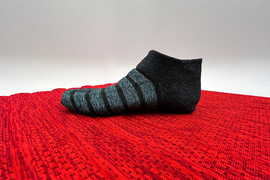
The team has designed a yarn made from a form of plastic that is commonly used in milk bottles and grocery bags. The new yarn, which has a feel similar to traditional sewing thread, can be woven into stretchy, lightweight clothing. The researchers say that at the end of its use, a yarn-spun garment could be melted down and redrawn into new yarn, and then woven into new clothing or even cast into buttons, belt buckles, and other plastic accessories.
To demonstrate the yarn’s recyclability, the researchers spun a spool of yarn, melted the yarn down, and respun it into new yarn, multiple times. They found that even after 10 cycles, the yarn was as strong and flexible as conventional thread.
They envision the new yarn could be an alternative to elastic spandex-polyester or spandex-nylon yarns, which are spun from a combination of fibers that cannot be recycled together. The team’s new yarn, in contrast, is made from a specific combination of plastic materials that mimics the tough and stretchy properties of spandex yarns, while also being easily recycled.
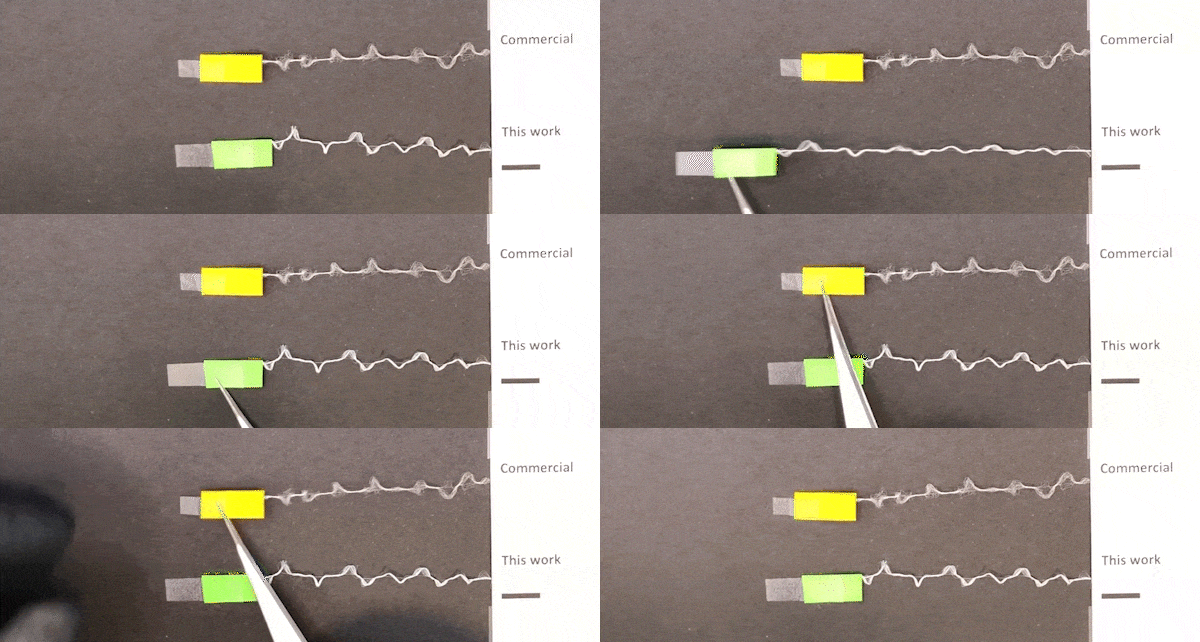
Credit: Courtesy of the researchers
“Eighty percent of textiles on the U.S. market currently contain some amount of spandex, which makes them nonrecyclable,” says Svetlana Boriskina, a research scientist in MIT’s Department of Mechanical Engineering. “There’s no widely adopted technology now that recycles textiles into textiles. With our new yarn, we hope to change that.”
Boriskina and her colleagues have published the details of the new yarn in a study published in the journal ACS Materials Letters. MIT co-authors include first author SeongHyeon Kim, Duo Xu, Volodymyr Korolovych, Domingo Flores-Hernandez, Kaniz Moriam, and Daniel Braconnier.
The core of the problem
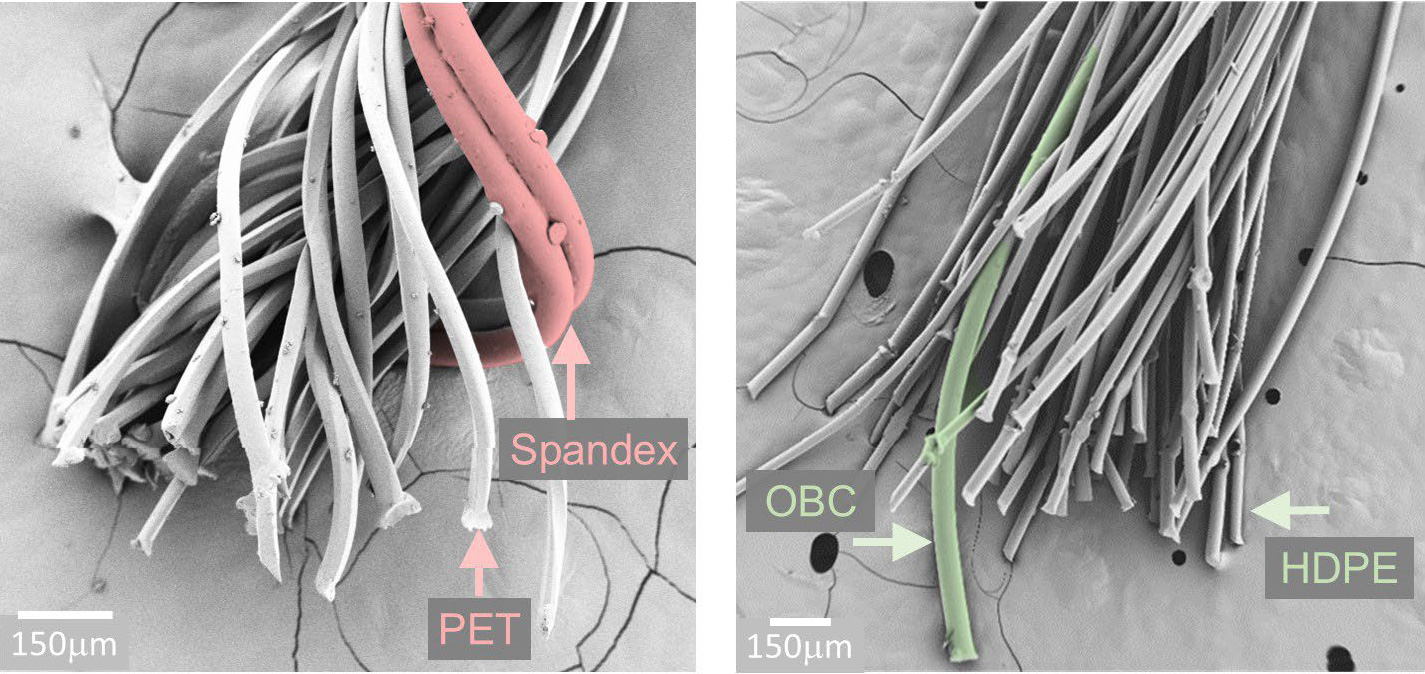
Spandex is a polyurethane-based synthetic fiber that is springy but not very strong. A thread of an elastic yarn is made from two parts: a spandex-based core, surrounded by a sheath of tough polyester or nylon. The combination of these materials gives elastic yarns their unique stretch and strength.
But this same material mixture makes elastic yarns nearly impossible to recycle. Yarns would first have to be chemically treated to separate the polyester sheath from the spandex core. The polyester-based sheath material could then be melted down and reused. But there is no way to recycle the yarn as a whole, without chemical separation.
“Even though chemical separation technologies exist, they add extra cost and complexity, and usually require toxic chemicals that are harmful to the environment,” Boriskina says. “That’s why most stretchy garments go to the dump.”
In 2021, Boriskina’s group developed a new type of yarn made from polyethylene. Polyethylene is the most common type of plastic in the world, used to make everything from grocery bags, water bottles, trash bins, and toys to industrial pipes and plastic sheeting. Polyethylene is a thermoplastic, meaning that it can be melted down and remade, and thus recycled.
And yet, polyethylene had never really been considered as a textile. In their previous work, Boriskina and her colleagues showed they could spin yarn out of polyethylene, which they then wove into various garments. In those experiments, they focused on the yarn’s moisture wicking, stain-resisting, and cooling properties.
Spaghetti yarn
In their new study, the group aimed to tailor polyethylene yarn to mimic the strength and flexibility of spandex; they also sought to demonstrate the yarn’s recyclability.
They first looked for formulations of stretchy, polyethylene-based copolymers that resemble a spandex elastic core. Separately, they engineered polyethylene yarns that can act as the sturdier sheath. Looking through the scientific literature and combing through industrial reports, the team evaluated many chemical variations of polyethylene.
“The chemical structure of polyethylene is like Christmas garland — a backbone of carbon, carbon, carbon, and also these dangling ‘decorations’ of hydrogen atoms or short branches with the same structure as a backbone,” Boriskina explains. “How these chains are arranged can change the properties of the whole structure.”
“Polyethylene can give us a wide range of properties, depending on how you make it,” adds first author SeongHyeon Kim.
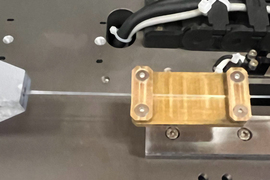
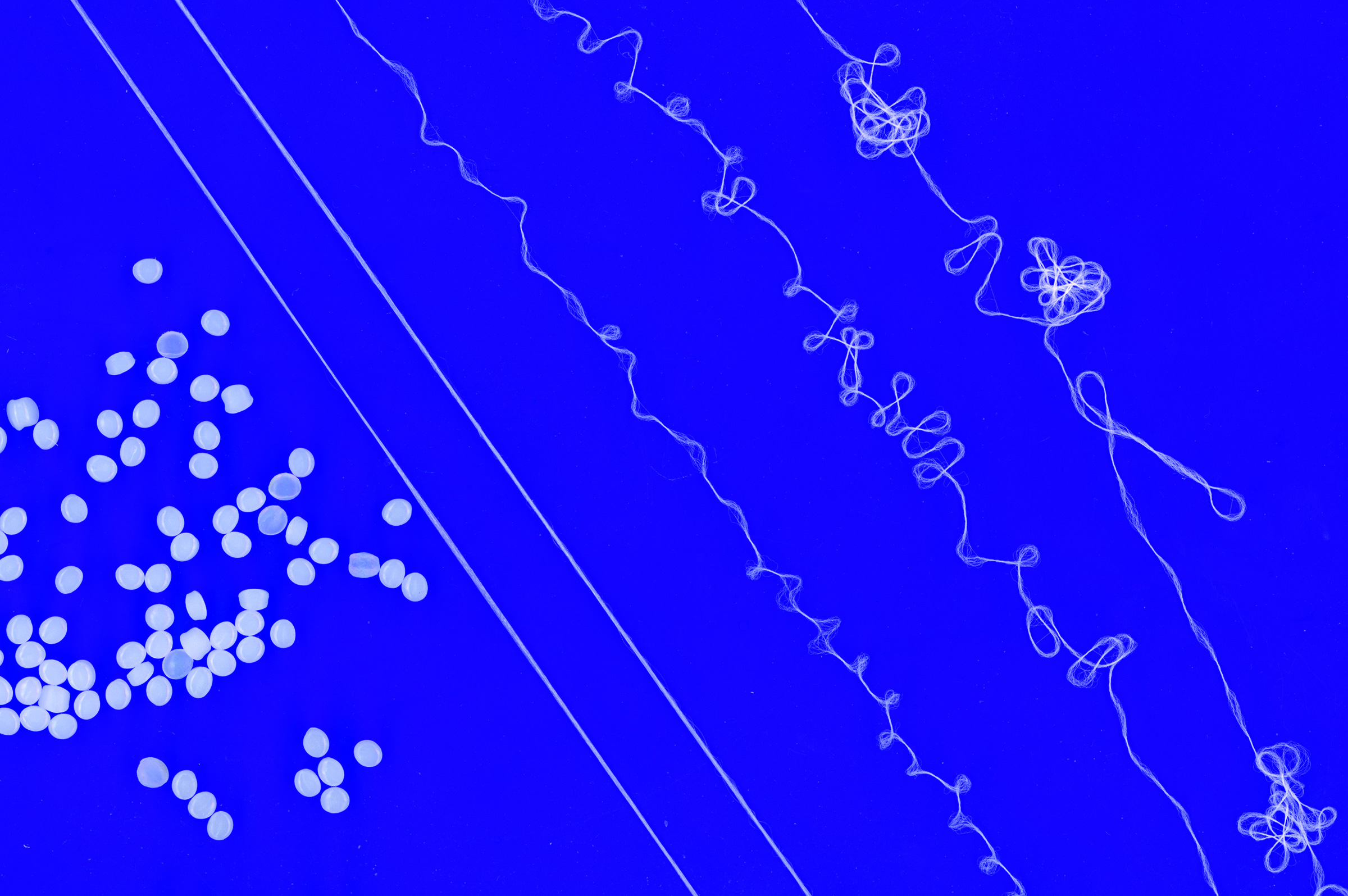
For the yarn’s core, the team used one polyethylene-based resin that results in a more stretchy fiber. They chose a second, stiffer resin as the basis for the yarn’s sheath. The researchers obtained pellets of each resin from a chemical manufacturer, and then put each type of pellet through a process of fiber fabrication, first pouring them into a hopper, then heating the pellets to about 350 degrees Fahrenheit, past their melting temperature. The melted polyethylene was then drawn through small extruders to make hair-thin fibers.
“You just melt it in a barrel with a heater, and then you extrude and spin it into fibers,” Kim says. “It’s like a spaghetti machine.”
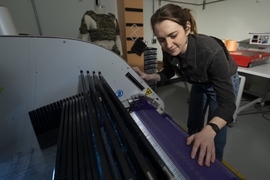
The team used an industrial yarn spinner to wind the sheath fibers around a core fiber to make the final, elastic yarn.
Because both the yarn’s core and sheath come from the same chemical family of polyethylene, Boriskina says the materials do not have to be separated before recycling, in contrast to spandex-based elastic yarns. The new yarn can be melted as is, and reformed into new yarn or other plastic products.
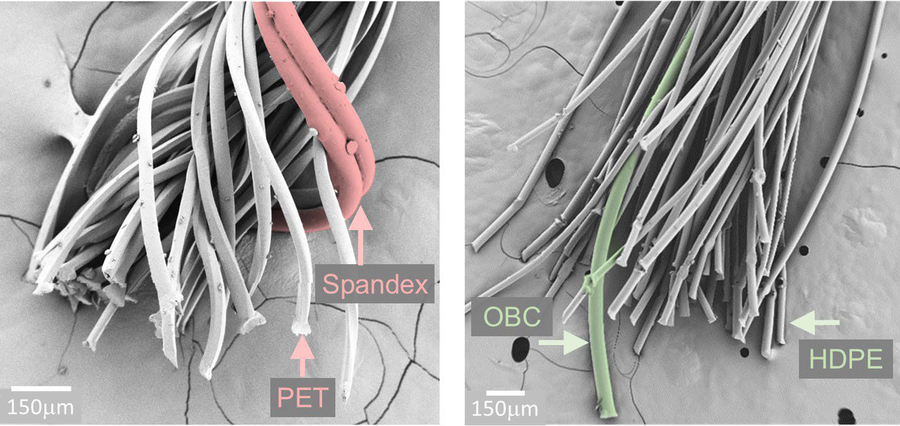
“Because they are exactly the same chemistry, they play nicely together,” she says. “That’s what makes this yarn very recyclable.”
As a demonstration, the team twisted an elastic core-sheath yarn, then melted it down and re-spun it, 10 times. Each time, they tested the yarn’s mechanical properties by precisely stretching a thread and measuring the pulling force at which the thread eventually broke. From these tests, they found that the yarn’s recycled versions were just as strong as the original sheath yarn. These recycled yarns can now be used to make new stetchy yarns by twisting them around a newly spun elastic core.
“Now we have something that can be knitted and woven,” Boriskina says. “That is the next stage.”
The team says their new recipe for polyethylene yarn can be scaled up into industrial-sized spools. Just like conventional spandex fibers, it would take kilometers of yarn to weave a single textile. But once woven and used, the team envisions that a polyethylene garment could conceivably be dropped in a recycling bin and sent to a facility to be melted down and respun, enabling a more sustainable, circular fashion and textile economy.
“Hopefully it will prevent the need for making more and more textile materials, because you can keep recycling a large portion of it,” Boriskina says.
This work was supported in part by the DEVCOM Soldier Center through the U.S. Army Research Office, the Office of Naval Research Global via Tecnologico de Monterrey, and the MIT Portugal Program.