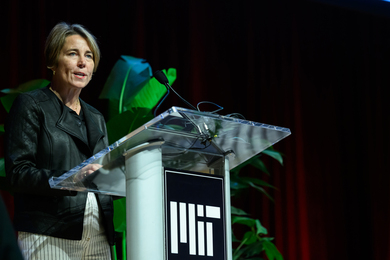
Evelyn Wang, the Esther and Harold E. Edgerton Career Development Assistant Professor in Mechanical Engineering, has been awarded an Air Force Office of Scientific Research Young Investigator Award for her work on advanced nanostructures for two-phase fluid and thermal transport.
The work aims to investigate advanced nanostructures to manipulate coupled fluidic and heat-transport processes for high-flux, two-phase microfluidic thermal-management systems. Specifically, her work will utilize nanostructure design to enhance heat transfer of both evaporator and condenser designs. Through experiments and modeling, fundamental understanding of detailed interactions at the liquid-vapor nanostructure interface will be pursued to realize the theoretical limits of two-phase cooling solutions.
The Air Force Office of Scientific Research will award approximately $16.5 million in grants to 43 scientists and engineers who submitted winning research proposals through the Air Force's Young Investigator Research Program. The objective of the program is to foster creative basic research in science and engineering, enhance early career development of outstanding young investigators, and increase opportunities for the young investigators to recognize the Air Force mission and the related challenges in science and engineering.
Read more
The work aims to investigate advanced nanostructures to manipulate coupled fluidic and heat-transport processes for high-flux, two-phase microfluidic thermal-management systems. Specifically, her work will utilize nanostructure design to enhance heat transfer of both evaporator and condenser designs. Through experiments and modeling, fundamental understanding of detailed interactions at the liquid-vapor nanostructure interface will be pursued to realize the theoretical limits of two-phase cooling solutions.
The Air Force Office of Scientific Research will award approximately $16.5 million in grants to 43 scientists and engineers who submitted winning research proposals through the Air Force's Young Investigator Research Program. The objective of the program is to foster creative basic research in science and engineering, enhance early career development of outstanding young investigators, and increase opportunities for the young investigators to recognize the Air Force mission and the related challenges in science and engineering.
Read more