
Astronomers pin down the origins of a planetary odd couple
New measurements of a hot Jupiter and its mini-Neptune companion suggest both planets formed surprisingly far away from their host star.
New measurements of a hot Jupiter and its mini-Neptune companion suggest both planets formed surprisingly far away from their host star.
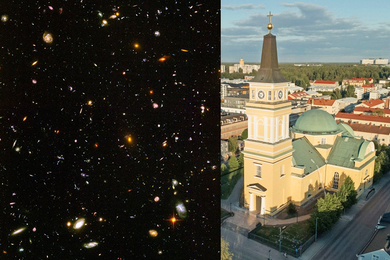
An immersive sound installation at Oulu Cathedral, Finland, co-created by MIT Associate Professor Kiyoshi Masui, transforms more than 4,000 cosmic signals into spatial audio.
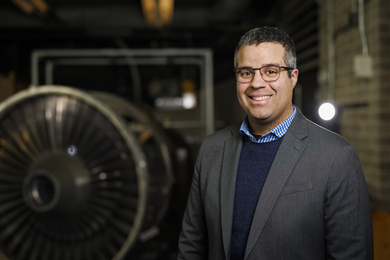
Associate Professor Richard Linares is helping satellites safely navigate in increasingly congested orbits.

From lazy ripples to towering breakers, waves should vary widely from one planet to another, according to a new model.
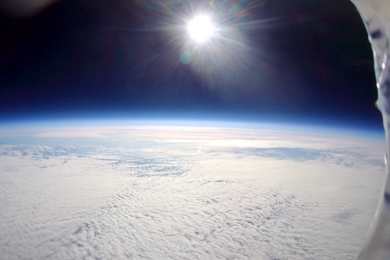
MIT students see the Earth's curvature in reborn AeroAstro intro course.
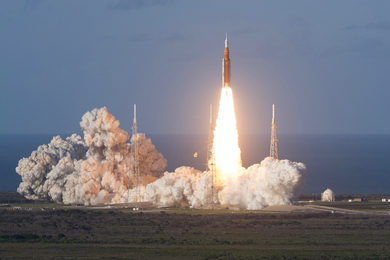
High-definition video and data sent from the lunar vicinity to Earth will demonstrate the first use of laser communications on a crewed mission.

On GBH’s new show The Curiosity Desk, MIT LIGO researchers revel in the beauties of fundamental discovery science and MIT astronomers talk planetary defense.
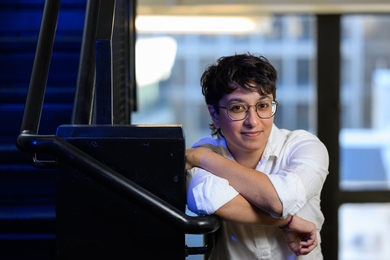
Using boron nitride nanotubes, mechanical engineering doctoral student Palak Patel develops materials for space that block dangerous ionizing radiation.

From early motion-sensing platforms to environmental monitoring, the professor and head of the Program in Media Arts and Sciences has turned decades of cross-disciplinary research into real-world impact.
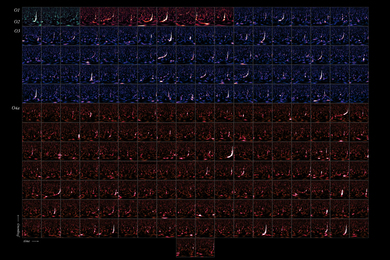
The latest crop of space-time wobbles includes a variety of heavy, fast-spinning, and lopsided colliding black holes.
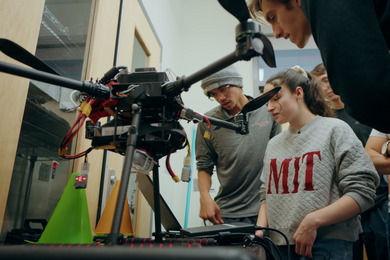
In 16.85 (Design and Testing of Autonomous Vehicles), AeroAstro students build software that allows autonomous flight vehicles to navigate unknown environments.

MIT physicists observed the first clear evidence that quarks create a wake as they speed through quark-gluon plasma, confirming the plasma behaves like a liquid.
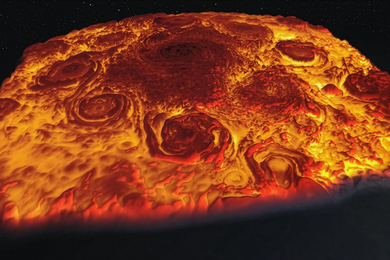
New research may explain the striking differences between the two planets’ polar vortex patterns.

Master's student Taylor Hampson is modeling the behavior of an unconventional rocket engine that will heat propellant using nuclear energy.

MIT community members made headlines with key research advances and their efforts to tackle pressing challenges.