What can make a dent?
Given the enormous scale of worldwide energy use, there are limited options for achieving significant reductions in greenhouse gas emissions.
Given the enormous scale of worldwide energy use, there are limited options for achieving significant reductions in greenhouse gas emissions.

Hybrid solar-thermoelectric systems could provide advantages over conventional solar cells or solar thermal plants.
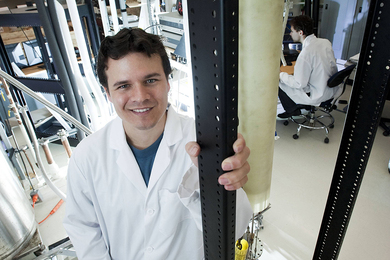
Finding could lead to new photodetectors or energy-harvesting devices.

Solar cell bonded to recently developed catalyst can harness the sun, splitting water into hydrogen and oxygen.

MIT team designs concentrated solar thermal system that could store heat in vats of molten salts, supplying constant power.
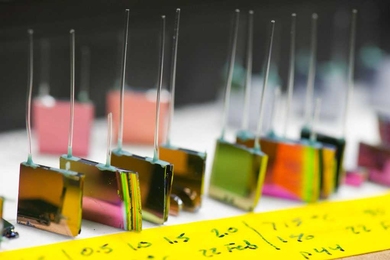
Materials engineered to give off precisely tuned wavelengths of light when heated are key to new high-efficiency generating system.

Modified carbon nanotubes can store solar energy indefinitely, then be recharged by exposure to the sun.

New MIT-developed materials make it possible to produce photovoltaic cells on paper or fabric, nearly as simply as printing a document.

MIT researchers develop a device that combines a solar cell with a catalyst to split water molecules and generate energy.
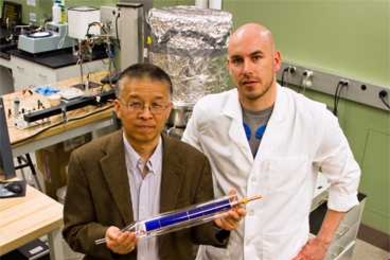
New system for flat-panel solar power could be combined with hot water systems for greater performance.

MIT researchers use genetically modified virus to produce structures that improve solar-cell efficiency by nearly one-third.

New technology from MIT could enable a building’s windows to generate power, without blocking the view.

A 1948 solar house designed by women stole the show at a 1950 symposium.