Accelerating science with AI and simulations
Associate Professor Rafael Gómez-Bombarelli has spent his career applying AI to improve scientific discovery. Now he believes we are at an inflection point.
Associate Professor Rafael Gómez-Bombarelli has spent his career applying AI to improve scientific discovery. Now he believes we are at an inflection point.

Driven by overuse and misuse of antibiotics, drug-resistant infections are on the rise, while development of new antibacterial tools has slowed.
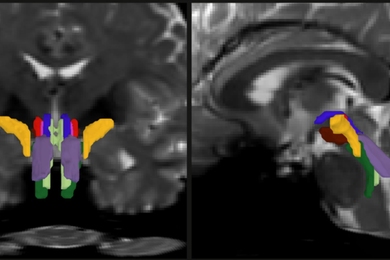
Opening a new window on the brainstem, a new tool reliably and finely resolves distinct nerve bundles in live diffusion MRI scans, revealing signs of injury or disease.
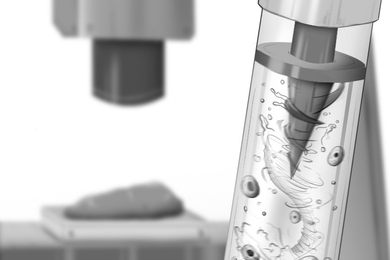
MagMix, an onboard mixing device, enables scalable manufacturing of 3D-printed tissues.
MIT Sports Lab researchers are applying AI technologies to help figure skaters improve. They also have thoughts on whether five-rotation jumps are humanly possible.
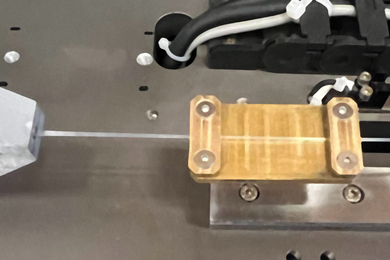
The flexible material could enable on-demand heat dissipation for electronics, fabrics, and buildings.

Removing just a tiny fraction of the crowdsourced data that informs online ranking platforms can significantly change the results.

MIT faculty join The Curiosity Desk to discuss football, math, Olympic figure skating, AI and the quest to cure ovarian cancer.

The first complete charting of foot traffic in any US city can be used for infrastructure decisions and safety improvements.

A new study suggests aerobic respiration began hundreds of millions of years earlier than previously thought.
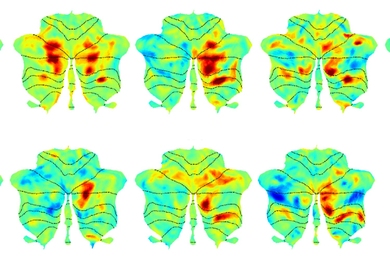
Researchers find a component of the brain’s dedicated language network in the cerebellum, a region better known for coordinating movement.

EnCompass executes AI agent programs by backtracking and making multiple attempts, finding the best set of outputs generated by an LLM. It could help coders work with AI agents more efficiently.
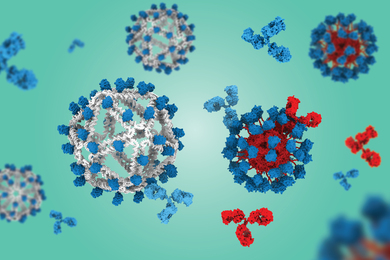
Based on a virus-like particle built with a DNA scaffold, the approach could generate broadly neutralizing antibody responses against HIV or influenza.
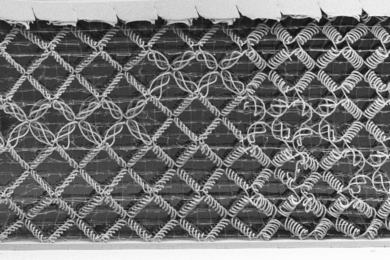
New framework supports design and fabrication of compliant materials such as printable textiles and functional foams, letting users predict deformation and material failure.

For the first time, the new scope allowed physicists to observe terahertz “jiggles” in a superconducting fluid.