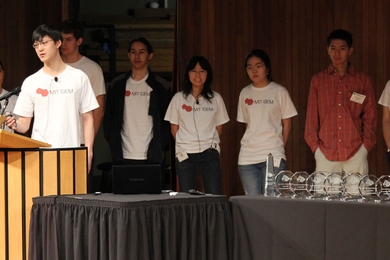
MIT team wins iGEM competition track
Group earns top spot in health and medicine; advances to grand finals for first time.
CSAIL robots take center stage
Computer Science and Artificial Intelligence Laboratory Principal Investigator Daniela Rus collaborated with modern dance company Pilobolus this past year to bring flying robots to the stage.
Rethinking the fall of Rome’s republic
Historian’s innovative hypothesis paints new picture of ancient Italy and aims to explain how the Roman Republic fell.


Oliva explores new ground in computational perception at CSAIL
Neuroscientist looks forward to collaborative studies of visual perception in the brain and its computational applications.
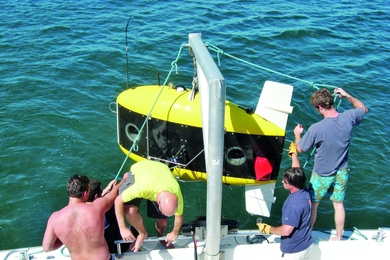
Navigating blindfolded
Advanced mathematical techniques enable AUVs to survey large, complex and cluttered seascapes.
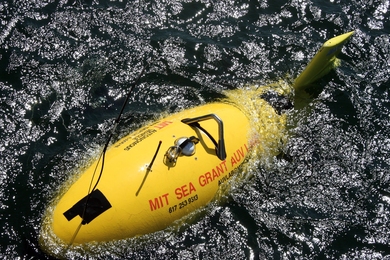
AUVs: From idea to implementation
One day, researchers predict, these robots will be able to do tasks without a human in the loop.
Many man-made and natural networks have same underlying architecture
In first DES4, Albert-László Barabási explains the concept of scale-free networks using the Web.

Making a Nobel-winning chemistry reaction even better
New catalyst offers greater control over the synthesis of organic cyclic compounds, including potential cancer drugs.

Exploring the inner workings of materials
From concrete to cancer cells, Van Vliet brings an engineer’s mindset to the study of biology and materials.
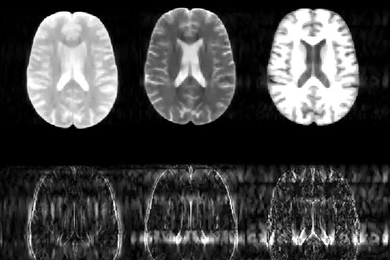
New algorithm could substantially speed up MRI scans
Faster scans could reduce the time patients spend in the machine from 45 to 15 minutes.
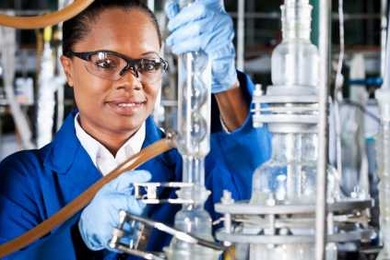
Foster the people
At manufacturing conference, emphasis is on keeping high-skill jobs in the United States — and creating workers with the talents to fill those positions.
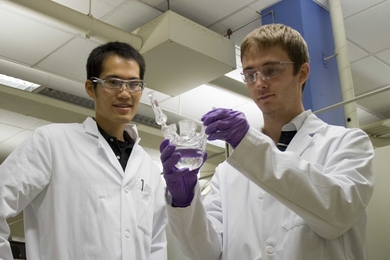
Highly efficient oxygen catalyst found
New catalyst, made of inexpensive and abundant materials, could prove useful in rechargeable batteries and hydrogen-fuel production.