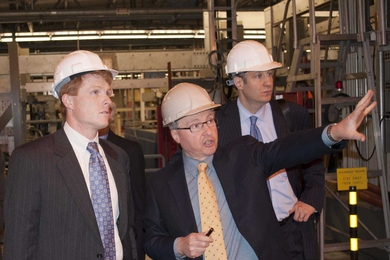
Lawmakers focus on MIT fusion research
Three Congressmen visited the Plasma Science and Fusion Center last week.
Three Congressmen visited the Plasma Science and Fusion Center last week.
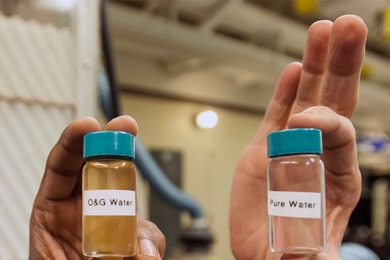
System developed at MIT cleans ‘produced water’ from natural gas wells, could lead to improved desalination plants for developing countries.
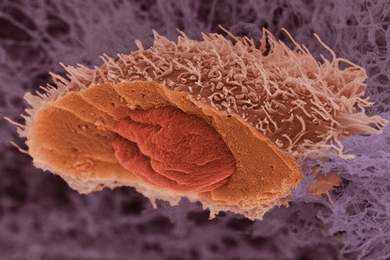
Surprising result suggests that enhancing these mutations’ impact could offer a new way to treat cancer.
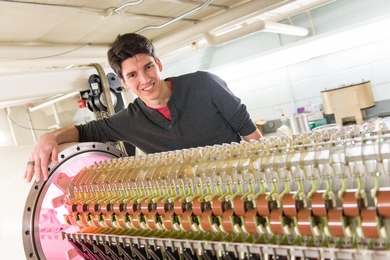
Jake Jurewicz, a nuclear science and engineering-physics double major, received a fellowship to develop new simulation and visualization software at the National Fusion Facility in California.
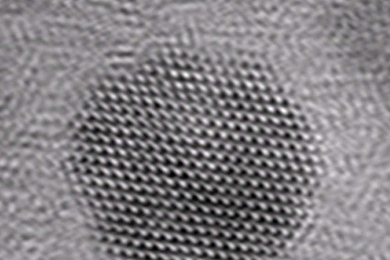
New production method could enable everything from more efficient computer displays to enhanced biomedical testing.

Researchers show how the vagaries of real-world circuitry affect the performance of a promising new technique in signal processing and imaging.
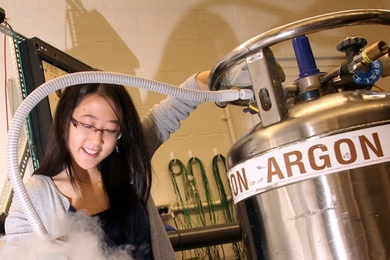
MIT senior Christie Chiu has found her focus: the study of tiny particles.
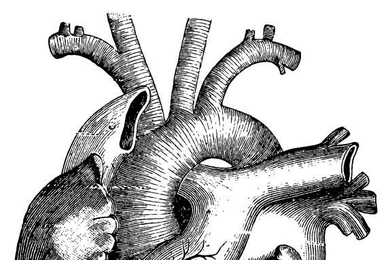
Biologists find that long non-coding RNA molecules are necessary to regulate differentiation of embryonic stem cells into cardiac cells.
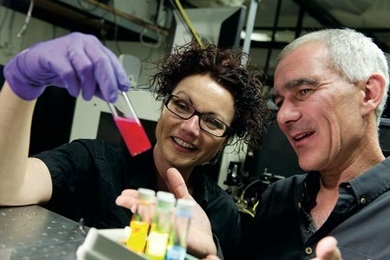
MIT investigators are inspired by a deep-sea bacterium that is able to harvest tiny amounts of incoming solar energy with exquisite efficiency.
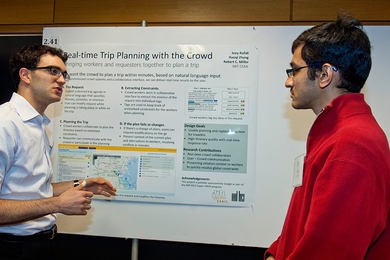
Poster session showcases student advances in key technologies and attracts faculty, venture capitalists and industry sponsors.
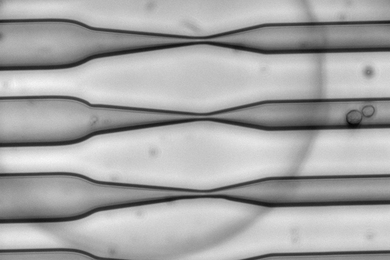
By deforming cells, researchers can deliver RNA, proteins and nanoparticles for many applications.
AeroAstro assistant professor, RLE research scientist among 40 winners
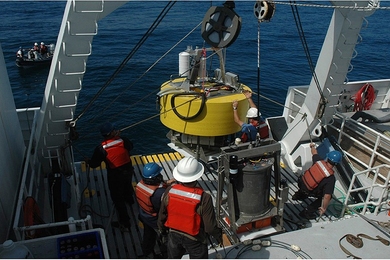
Scientists track ocean microbe populations in their natural habitat to create a ‘day in the life’ montage.
Ceramic forms of hydrophobic materials could be far more durable than existing coatings or surface treatments.

MIT anthropologist’s new book recounts the painful aftermath when steel plants suddenly closed in the American heartland.