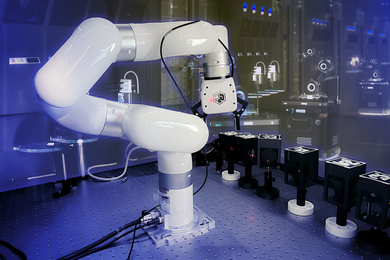
Robotic lab sets up and runs optics experiments on demand
The autonomous system could speed up testing of high-tech materials for applications such as solar cells, sensors, video displays, and quantum technologies.
The autonomous system could speed up testing of high-tech materials for applications such as solar cells, sensors, video displays, and quantum technologies.
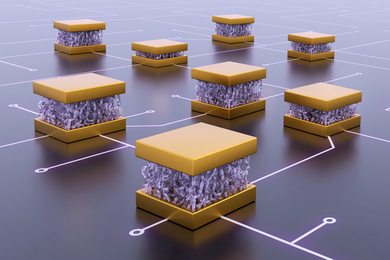
A new device uses reconfigurable motion to mimic the firing behavior of a neuron, which could lead to more efficient computing.
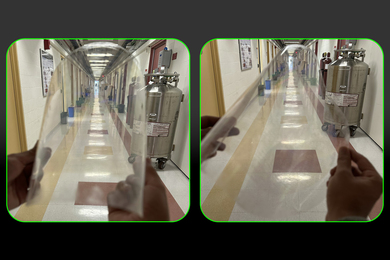
This scalable process produces high-performance chips for applications like discreet wearables or pliable augmented-reality displays.

This advance could be a big step toward developing a scalable, practical quantum computer.

Due to physical and fundamental limitations, an earlier proposal for producing laserlike beams of neutrinos cannot be achieved, scientists report.
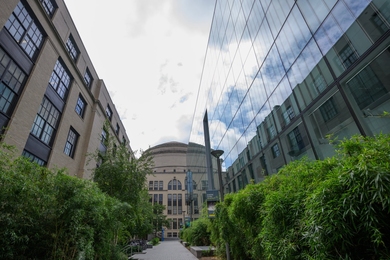
The Institute welcomes its first cohort of QMIT Fellows this fall to advance interdisciplinary quantum research.

A new, scalable technique could enable powerful radars and sensors based on quantum technology that works at room temperature.
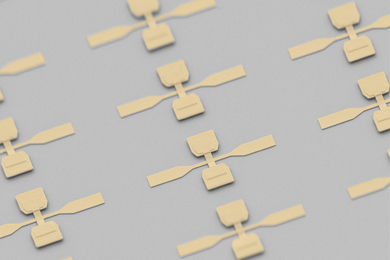
A new fabrication platform integrates molecules into electronic devices, opening the door to emerging computing technologies.
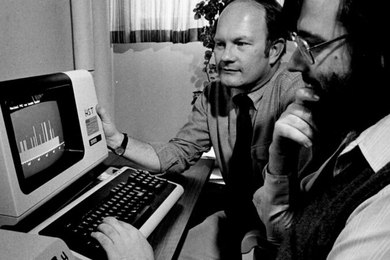
The visionary PhysioNet platform launched 25 years ago, based on a system developed at MIT in the 1970s. It has become one of the most comprehensive biomedical and clinical data repositories in existence.
Initial research projects advance national priorities across natural resources, manufacturing, nuclear physics, and more.
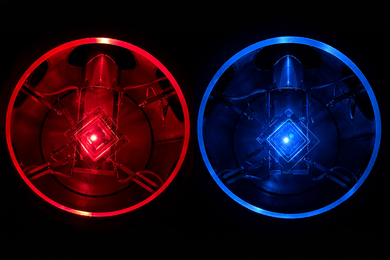
Researchers found a simple solution for extending the lifespans of LEDs made from glowing microscopic particles called quantum dots.
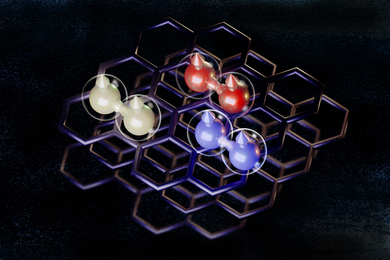
What’s more, the superconducting states get stronger under conditions expected to kill them.
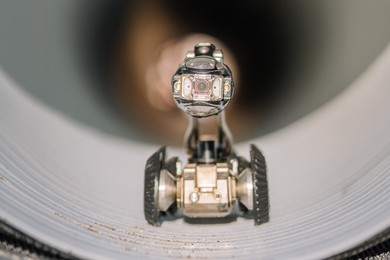
Researchers combined an efficient algorithm with dedicated hardware to rapidly generate 3D maps for navigation using minimal memory and power.
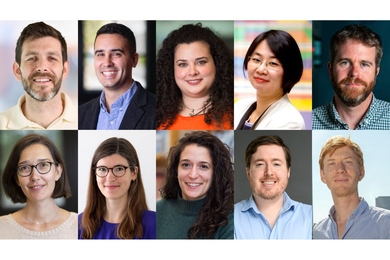
Ten faculty members have been granted tenure in five units across MIT’s School of Engineering.
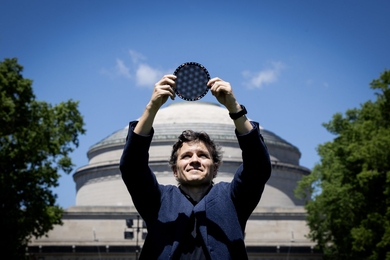
The MIT physicist shares the honor with two others for foundational research establishing the field of twistronics.