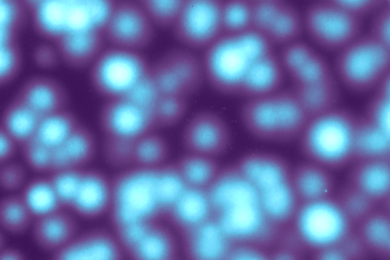
Forming patches boosts bacterial life
By clustering, cells can work together to survive challenging environments, MIT researchers show.
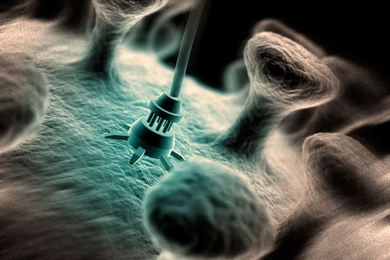
Physicists prove energy input predicts molecular behavior
Theoretical proof could lead to more reliable nanomachines.
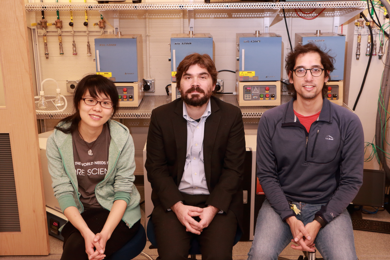
Faculty highlight: Joseph Checkelsky
Synthesizing new physics: Assistant professor blends materials science and solid state physics to uncover new properties linked to collective behavior of electrons.

The beginning of the end for encryption schemes?
New quantum computer, based on five atoms, factors numbers in a scalable way.
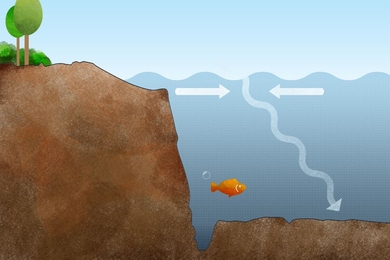
New theory of deep-ocean sound waves may aid tsunami detection
Surface waves can trigger powerful sound waves that race through the deep ocean, study suggests.
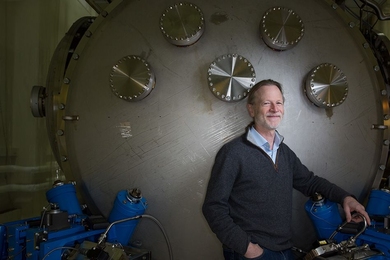
Testimony: LIGO has “cracked open” a new window to the universe
MIT’s David Shoemaker testifies before Congress on the significance of LIGO.

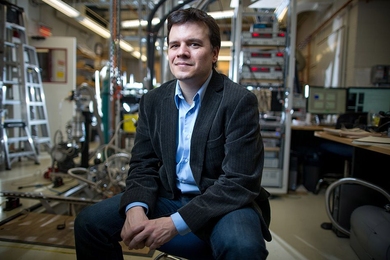
In Profile: Pablo Jarillo-Herrero
Experimental physicist explores the wild frontiers of graphene and other ultrathin materials.
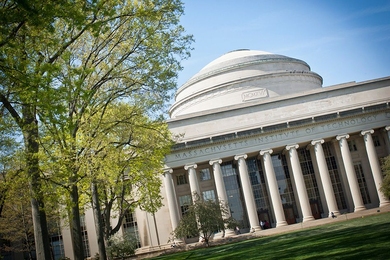
Eleven MIT researchers win Sloan Research Fellowships
Faculty from eight MIT science and engineering departments among 126 selected from across the U.S. and Canada.
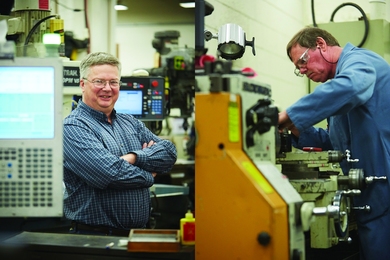
The Central Machine Shop builds parts that make MIT research work
A secret to the success of many projects at MIT, the Central Machine Shop helps students, faculty, and staff build just about anything that can be machined.
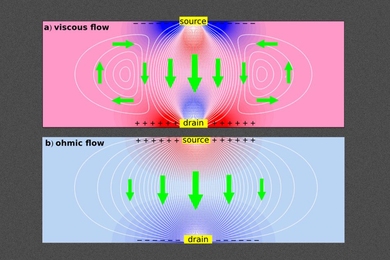
How to make electrons behave like a liquid
Analysis predicts exotic behaviors such as “negative resistance,” based on fluid-like effects.
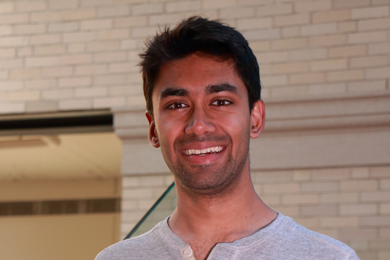
Crunching quantum code
MIT physics graduate student Sagar Vijay co-develops error correction method for quantum computing based on special electronic states called Majorana fermions.

Amelia Trainer: Structuring improved simulations for reactor physics
MIT sophomore is passionate about coding projects that model neutron behavior inside nuclear reactors.