Keeping an eye on the fusion future
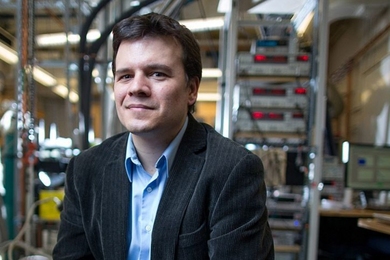
Daniel Korsun’s undergraduate career at MIT prepared him to look more deeply into fusion magnet technology and design.
Longtime MIT professor who laid the foundations for the development of index theory was a recipient of both the National Medal of Science and the Abel Prize.
MIT scientists present exoplanet data at the 237th American Astronomical Society meeting.
Unconventional form of ferroelectricity could impact next-generation computing.
Thirteen postdocs and research scientists honored for contributions to the Institute with awards formerly known as Infinite Kilometer.
In a new MIT class, students explore how STEM researchers bring their knowledge to major societal issues.
Senior Alana Sanchez combines her interests in visual arts and space research to fulfill a childhood curiosity about the cosmos.
Structure may reveal conditions needed for high-temperature superconductivity.
Findings suggest the first galaxies in the universe were more massive than previously thought.
For decades, experts at the Institute have been shaping the future of the game.
Pablo Jarillo-Herrero, Aviv Regev, Susan Solomon, and Feng Zhang are the recipients of distinguished awards for major contributions to science.
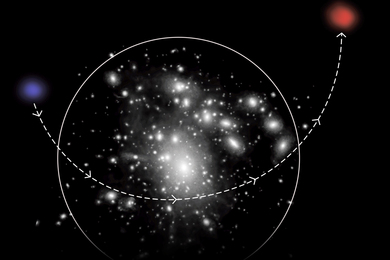
Results significantly narrow the range of possible places to find the hypothetical dark matter particles.
Associate professor of physics shares the honor with colleague Phillip Mocz for their novel dark matter research.
To understand ourselves and our place in the universe, “we should have humility but also self-respect,” the physicist writes in a new book.
Research suggests the products of transcription — RNA molecules — regulate their own production through a feedback loop.