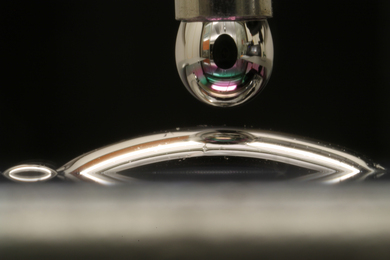
Controlling how “odd couple” surfaces and liquids interact
Spread out or bead up? A new process enables control over liquid-solid interfaces even with the most unlikely pairs of materials.
Spread out or bead up? A new process enables control over liquid-solid interfaces even with the most unlikely pairs of materials.
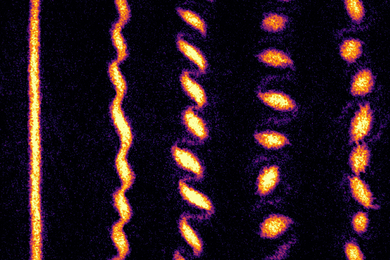
The new observations record a key crossover from classical to quantum behavior.
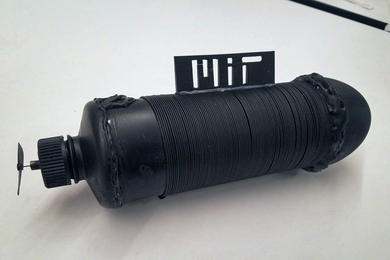
The rechargeable battery can be woven and washed, and could provide power for fiber-based electronic devices and sensors.

The new machine-learning system can generate a 3D scene from an image about 15,000 times faster than other methods.
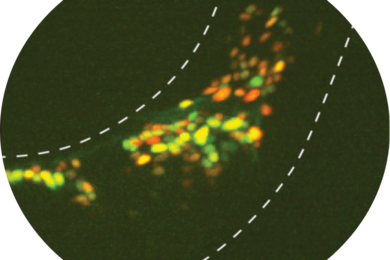
By integrating multiple sensory inputs, a loop of mutual inhibition among a small set of neurons allows worms to switch between long-lasting behavioral states.
The potent new adjuvant could be used to help make vaccines against HIV and other infectious diseases.
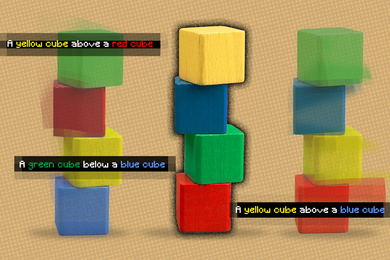
A new machine-learning model could enable robots to understand interactions in the world in the way humans do.
New approach solves a persistent problem of intermittency that has hindered use of the tiny light emitters for biological imaging or quantum photonics.
A new study confirms that as atoms are chilled and squeezed to extremes, their ability to scatter light is suppressed.
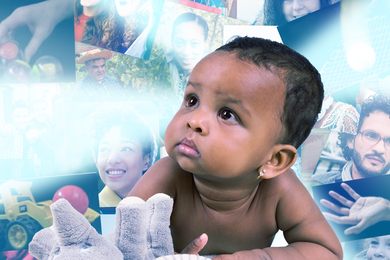
Study suggests this area of the visual cortex emerges much earlier in development than previously thought.
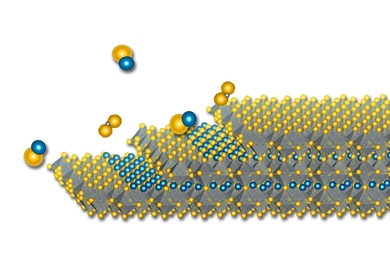
Ultrastable and made of inexpensive, nontoxic elements, chalcogenide perovskites could find applications in solar cells, lighting, and more.
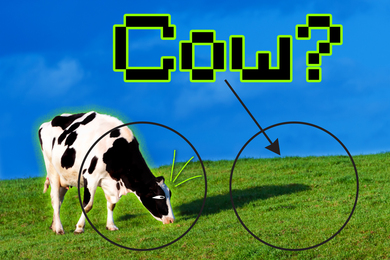
A new method forces a machine learning model to focus on more data when learning a task, which leads to more reliable predictions.
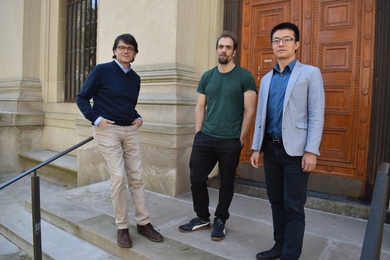
A National Science Foundation-funded team will use artificial intelligence to speed up discoveries in physics, astronomy, and neuroscience.
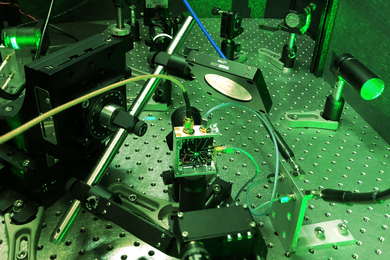
MIT researchers develop a new way to control and measure energy levels in a diamond crystal; could improve qubits in quantum computers.

Neuroscientists find the internal workings of next-word prediction models resemble those of language-processing centers in the brain.