How nature organizes itself, from brain cells to ecosystems
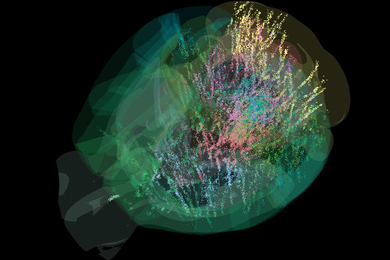
McGovern Institute researchers develop a mathematical model to help define how modularity occurs in the brain — and across nature.
Enhancing activity of a specific component of neurons’ “NMDA” receptors normalized protein synthesis, neural activity, and seizure susceptibility in the hippocampus of fragile X lab mice.
Graduate student and MathWorks Fellow Louis DeRidder is developing a device to make chemotherapy dosing more accurate for individual patients.
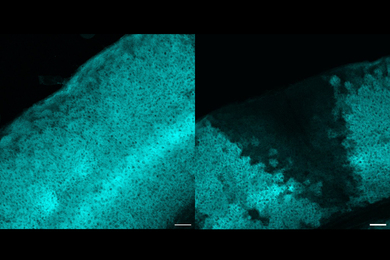
New methods light up lipid membranes and let researchers see sets of proteins inside cells with high resolution.
New research adds evidence that learning a successful strategy for approaching a task doesn’t prevent further exploration, even if doing so reduces performance.
Xiao Wang’s studies of how and where RNA is translated could lead to the development of better RNA therapeutics and vaccines.
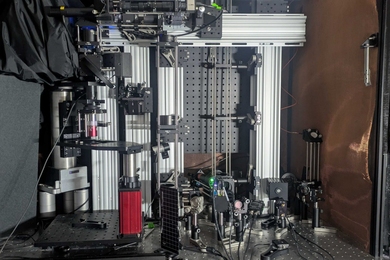
Tissue processing advance can label proteins at the level of individual cells across large samples just as fast and uniformly as in dissociated single cells.
Cognitive neuroscientist is recognized for her groundbreaking discoveries about the brain’s language system.
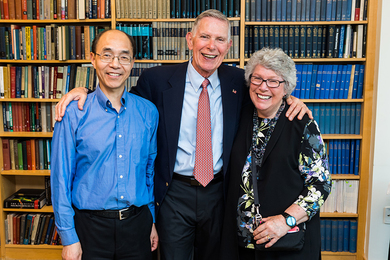
An MIT affiliate for some 60 years, Schneider was an authority on the relationships between brain structure and behavior.
By studying the roundworm C. elegans, neuroscientist Steven Flavell explores how neural circuits give rise to behavior.
A new computational model explains how neurons linked to spatial navigation can also help store episodic memories.
Machine-learning models let neuroscientists study the impact of auditory processing on real-world hearing.
Place cells are known to encode individual locations, but research finds stitching together a “cognitive map” of a whole environment requires a broader ensemble of cells, aided by sleep, over several days.
McGovern Institute neuroscientists use children’s interests to probe language in the brain.
The neuroscientist turned entrepreneur will focus on advancing the intersection of behavioral science and AI across MIT.