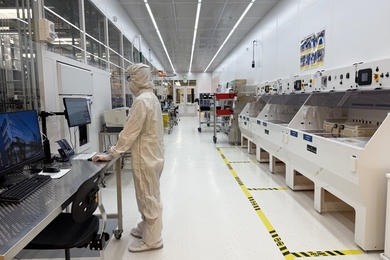
Powering 160,000 hours of discovery at MIT.nano
NanoFab Equipment Management and Operations (NEMO) system streamlines shared facilities management via tool trainings, reservations, and lab communications.
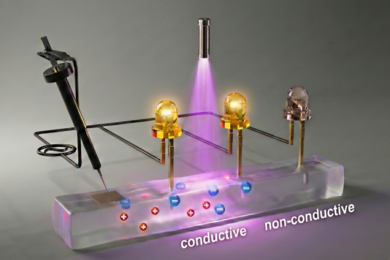
New MIT work advances the growing field of ionotronics, in which data are transferred through ions, potentially providing a bridge between electronics and biological tissue.
For the first time, the new scope allowed physicists to observe terahertz “jiggles” in a superconducting fluid.
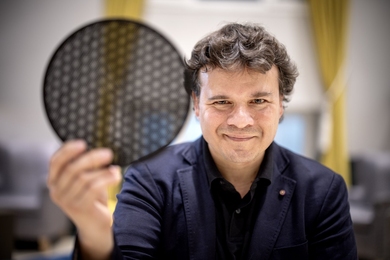
MIT physicist shares 400,000-euro award for influential work on “magic-angle” graphene.
Jiaqi Cai and Zhengguang Lu independently discovered that electrons can become fractions of themselves.
Founder Gregory B. Olson reflects on past and continuing high-impact work as the group turns 40.
The MRL helps bring together academia, government, and industry to accelerate innovation in sustainability, energy, and advanced materials.
Film produced by MIT Open Learning’s video team shows the art and science of hand-forged knives with master bladesmith Bob Kramer.
Nanophotonic devices developed at MIT are compact, efficient, reprogrammable, adaptive, and able to dynamically respond to external inputs.
Speakers described challenges and potential solutions for producing materials to meet demands associated with data centers, infrastructure, and other technology.
Metallurgist brings experience in interdisciplinary collaboration and close engagement with industry.
Rhombohedral graphene reveals new exotic interacting electron states.
The work introduces a new platform for studying quantum materials.
The work opens new avenues for understanding and manipulating electrons in materials.
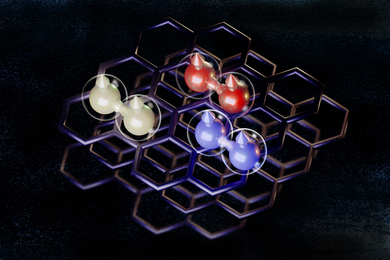
New work suggests the ability to create fractionalized electrons known as non-Abelian anyons without a magnetic field, opening new possibilities for basic research and future applications.