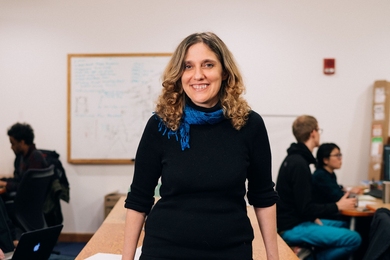
Putting data in the hands of doctors
Computer scientist Regina Barzilay empowers cancer treatment with machine learning.
Computer scientist Regina Barzilay empowers cancer treatment with machine learning.
Low-power special-purpose chip could make speech recognition ubiquitous in electronics.
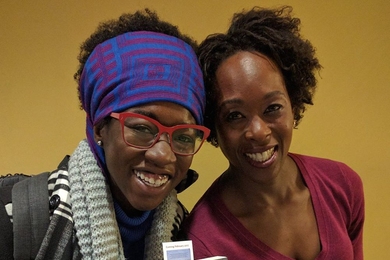
Media Lab graduate student selected from over 7,300 entrants, awarded $50,000 scholarship in contest inspired by the film "Hidden Figures."

Fund establishes a global initiative to advance artificial intelligence research for the public good.
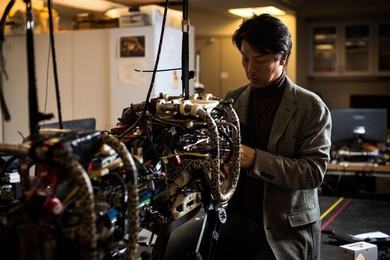
Mechanical engineer Sangbae Kim builds animal-like machines for use in disaster response.

Preserving variety in subsets of unmanageably large data sets should aid machine learning.

Technique shrinks data sets while preserving their fundamental mathematical relationships.

System correlates recorded speech with images, could lead to fully automated speech recognition.

Machine-learning system doesn’t require costly hand-annotated data.
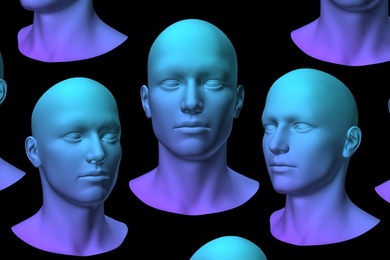
Machine-learning system spontaneously reproduces aspects of human neurology.
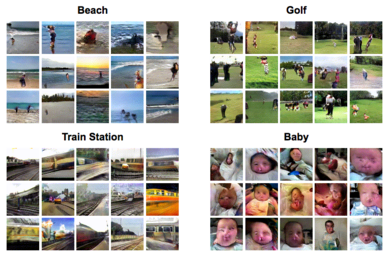
Given a still image, CSAIL deep-learning system generates videos that predict what will happen next in a scene.

Industry leaders, computer scientists, and venture capitalists gather to discuss how smarter computers are remaking our world.

“Information extraction” system helps turn plain text into data for statistical analysis.
New training technique would reveal the basis for machine-learning systems’ decisions.
New model-fitting technique is efficient even for data sets with hundreds of variables.