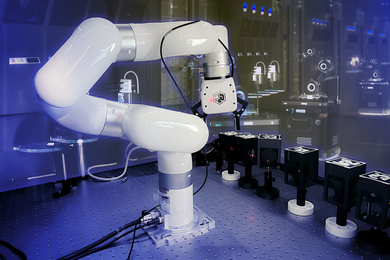
Robotic lab sets up and runs optics experiments on demand
The autonomous system could speed up testing of high-tech materials for applications such as solar cells, sensors, video displays, and quantum technologies.
The autonomous system could speed up testing of high-tech materials for applications such as solar cells, sensors, video displays, and quantum technologies.
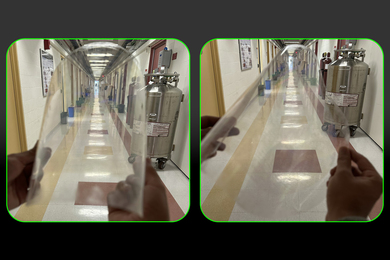
This scalable process produces high-performance chips for applications like discreet wearables or pliable augmented-reality displays.

The tunable device controls mid-infrared light for more precise thermal imaging, chemical sensing, or pollution monitoring.
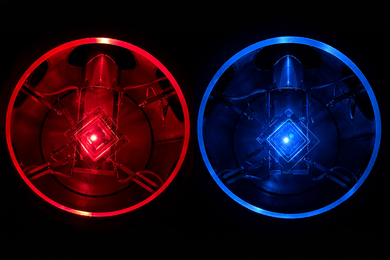
Researchers found a simple solution for extending the lifespans of LEDs made from glowing microscopic particles called quantum dots.

With a novel design, MIT researchers overcame a stubborn problem that has limited the effectiveness of chip-based systems for lidar.
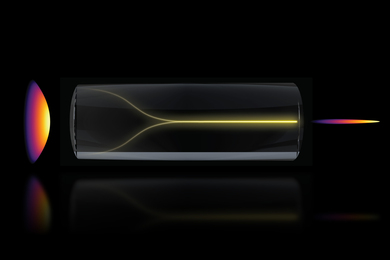
MIT researchers leveraged a surprise discovery to devise a faster and more precise biomedical imaging technique.
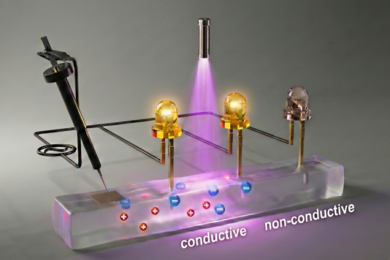
New MIT work advances the growing field of ionotronics, in which data are transferred through ions, potentially providing a bridge between electronics and biological tissue.

The portable “ChromoLCD” device combines LCD and LED lighting to customize high-quality designs onto things like shirts and whiteboards.

New technique could improve the scalability of trapped-ion quantum computers, an essential step toward making them practically useful.
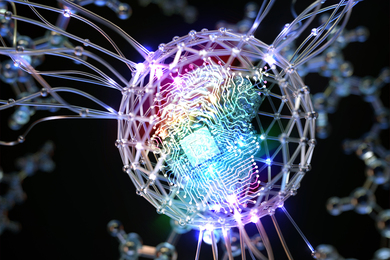
Acting as a “virtual spectrometer,” SpectroGen generates spectroscopic data in any modality, such as X-ray or infrared, to quickly assess a material’s quality.

Nanophotonic devices developed at MIT are compact, efficient, reprogrammable, adaptive, and able to dynamically respond to external inputs.

The research may enable the design of synthetic, light-activated cells for wound healing or drug delivery.

As part of a high-resolution biosensing device without wires, the antennas could help researchers decode intricate electrical signals sent by cells.
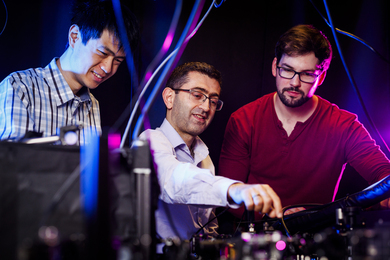
The technique provides researchers with a powerful tool for controlling magnetism, and could help in designing faster, smaller, more energy-efficient memory chips.
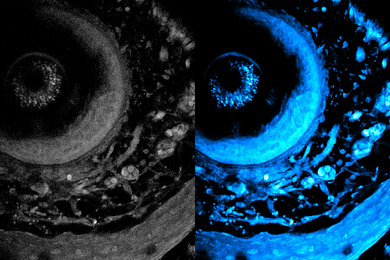
Using high-powered lasers, this new method could help biologists study the body’s immune responses and develop new medicines.