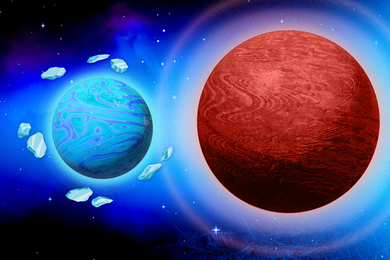
Astronomers pin down the origins of a planetary odd couple
New measurements of a hot Jupiter and its mini-Neptune companion suggest both planets formed surprisingly far away from their host star.
New measurements of a hot Jupiter and its mini-Neptune companion suggest both planets formed surprisingly far away from their host star.

From lazy ripples to towering breakers, waves should vary widely from one planet to another, according to a new model.

PhD student Carissma McGee studies exoplanets and examines intellectual property frameworks for space collaborations.

A proposed telescope made of thousands of tiny, identical satellites will work to reveal low-frequency radio waves in space.
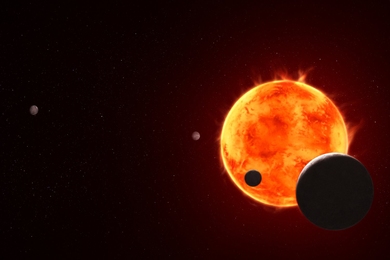
Astronomers led by EAPS postdoc Ana Glidden ruled out several atmospheric scenarios for the planet, narrowing ideas of what habitability there might look like.
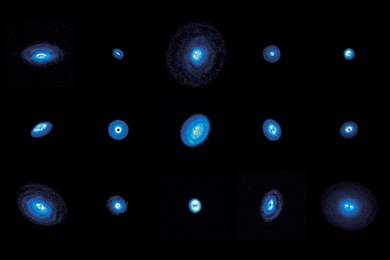
Led by Assistant Professor Richard Teague, a team of international astronomers has released a collection of papers and public data furthering our understanding of planet formation.

The fellowship supports research contributing to the field of planetary science and astronomy.
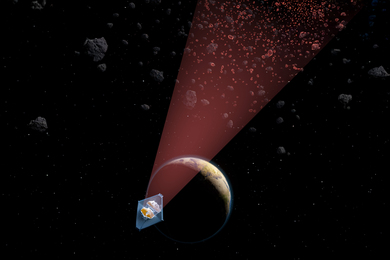
The team’s detection method, which identified 138 space rocks ranging from bus- to stadium-sized, could aid in tracking potential asteroid impactors.
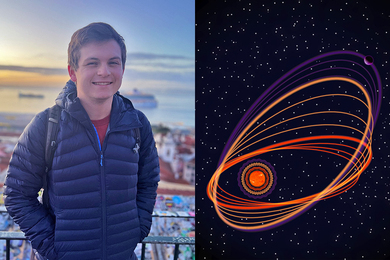
EAPS PhD student Jared Bryan found a way to use his research on earthquakes to help understand exoplanet migration.
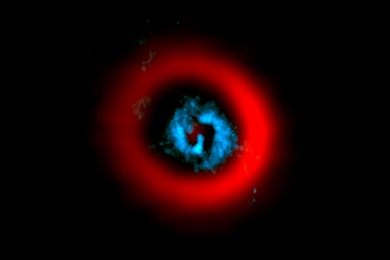
Assistant Professor Richard Teague describes how movement of unstable gas in a protoplanetary disk lends credibility to a secondary theory of planetary formation.
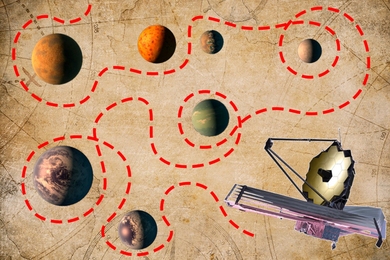
Scientists created the step-by-step guide to unlock the potential of NASA’s James Webb Space Telescope for identifying habitable worlds in the universe.
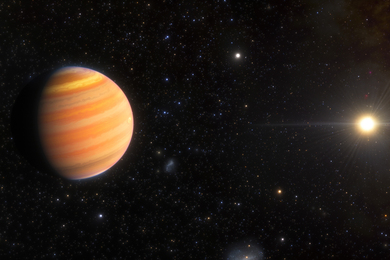
The planet’s wild orbit offers clues to how such large, hot planets take shape.

American Astronomical Society’s Division on Dynamical Astronomy honors the assistant professor and MIT Kavli member for contributions to the dynamics of multi-planet extrasolar systems.
Circling a cold, Jupiter-sized star, the new world could offer an unobstructed view of its surface composition and history.
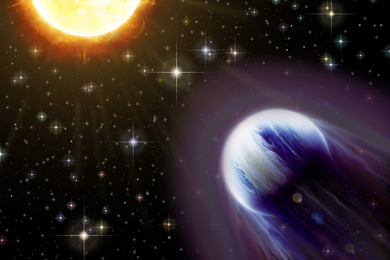
The new world is the second-lightest planet discovered to date.