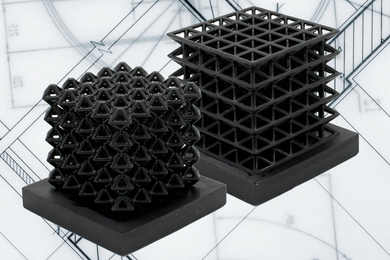
New programmable materials can sense their own movements
Engineers 3D print materials with networks of sensors directly incorporated.
Download RSS feed: News Articles / In the Media / Audio
Engineers 3D print materials with networks of sensors directly incorporated.

The MIT researcher and former professor discusses how Covid-19 and the influx of virtual technologies created a new medical ecosystem that needs more synchronized oversight.
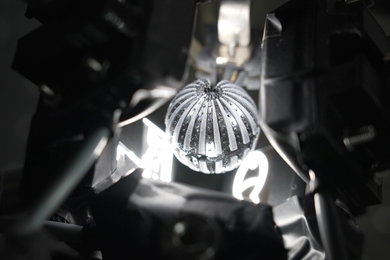
Inspired by a fiddler crab eye, scientists developed an amphibious artificial vision system with a panoramic visual field.

Algorithms designed to ensure multiple users share a network fairly can’t prevent some users from hogging all the bandwidth.
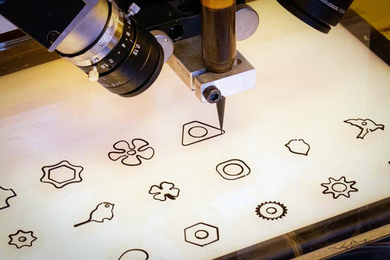
Researchers train a machine-learning model to monitor and adjust the 3D printing process to correct errors in real-time.

Using a randomized field experiment, researchers discover that Wikipedia articles affect judges’ legal reasoning.

Neuroscience professor and Science Hub investigator Ted Adelson explains how simulating the sense of touch with a camera can make robots smarter.

MassRobotics, a nonprofit founded by several MIT alumni, is advancing an industry that will play an increasingly important role in our lives.

“Interpretability methods” seek to shed light on how machine-learning models make predictions, but researchers say to proceed with caution.

MIT researchers create KineCAM, an instant camera that yields images that appear to move.

Professor of electrical engineering and computer science will receive additional support to advance his research and career.

With FabO, PhD student Dishita Turakhia wants to empower students to learn digital fabrication by making video game objects and characters come alive.

Researchers have made strides toward machine-learning models that can help doctors more efficiently find information in a patient’s health record.
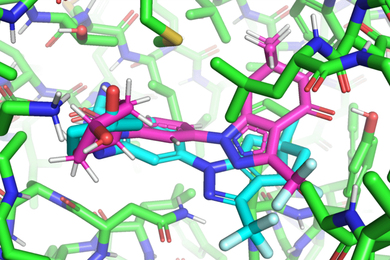
A geometric deep-learning model is faster and more accurate than state-of-the-art computational models, reducing the chances and costs of drug trial failures.
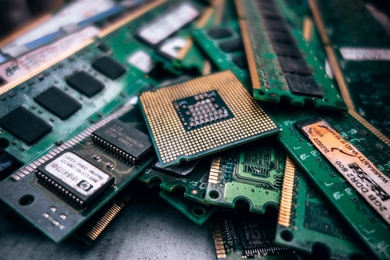
Researchers created Exo for writing high-performance code on hardware accelerators.