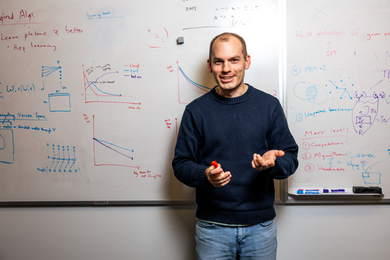
Understanding the nuances of human-like intelligence
Associate Professor Phillip Isola studies the ways in which intelligent machines “think,” in an effort to safely integrate AI into human society.
Associate Professor Phillip Isola studies the ways in which intelligent machines “think,” in an effort to safely integrate AI into human society.
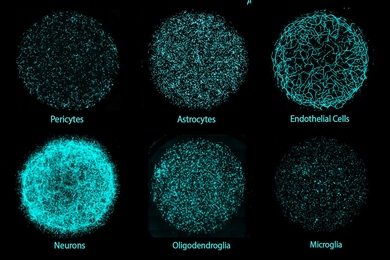
Cultured from induced pluripotent stem cells, “miBrains” integrate all major brain cell types and model brain structures, cellular interactions, activity, and pathological features.

While most states mandate screenings to guide early interventions for children struggling with reading, many teachers feel underprepared to administer and interpret them.
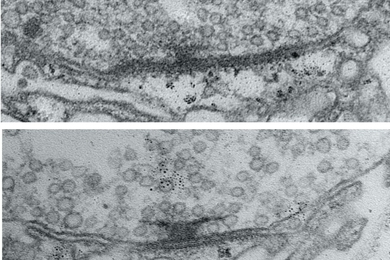
Scientists identified how circuit connections in fruit flies tune to the right size and degree of signal transmission capability. Understanding this could lead to a way to tweak abnormal signal transmission in certain disorders.

Media Lab PhD student Kimaya Lecamwasam researches how music can shape well-being.
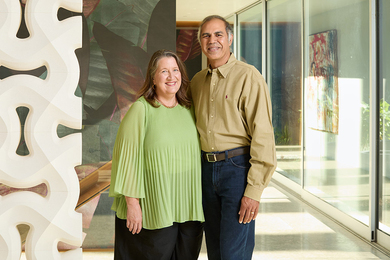
The Rare Brain Disorders Nexus aims to accelerate the development of novel therapies for a spectrum of uncommon brain diseases.
Speakers at MIT’s Aging Brain Initiative symposium described how immune system factors during aging contribute to Alzheimer’s, Parkinson’s and other conditions. The field is leveraging that knowledge to develop new therapies.
Brain imaging suggests people with musical training may be better than others at filtering out distracting sounds.

Sentences that are highly dissimilar from anything we’ve seen before are more likely to be remembered accurately.
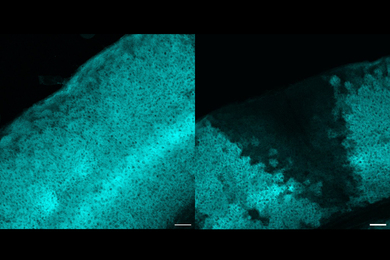
MIT researchers employed a novel application of tools and analysis to show that astrocytes ensure neural information processing by maintaining ambient levels of the neurotransmitter chemical GABA.

As an object moves across your field of view, the brain seamlessly hands off visual processing from one hemisphere to the other like cell phone towers or relay racers do, a new MIT study shows.
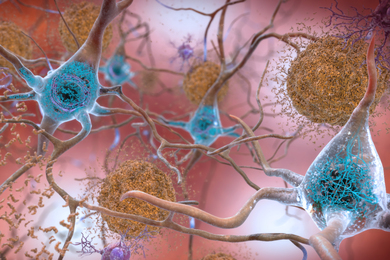
Lipid metabolism and cell membrane function can be disrupted in the neurons of people who carry rare variants of ABCA7.
Study of 3.5 million cells from more than 100 human brains finds Alzheimer’s progression — and resilience to disease — depends on preserving epigenomic stability.
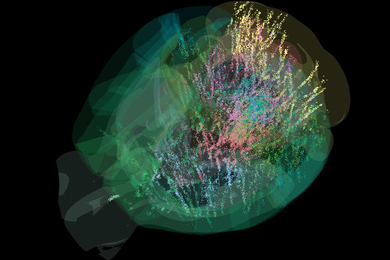
An international collaboration of neuroscientists, including MIT Professor Ila Fiete, developed a brain-wide map of decision-making at cellular resolution in mice.
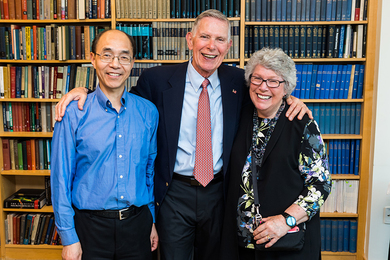
A commitment from longtime supporters Patricia and James Poitras ’63 initiates multidisciplinary efforts to understand and treat complex psychiatric disorders.