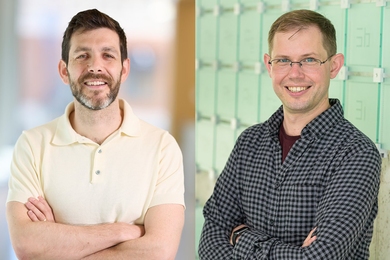
Jacob Andreas and Brett McGuire named Edgerton Award winners
The associate professors of EECS and chemistry, respectively, are honored for exceptional contributions to teaching, research, and service at MIT.
The associate professors of EECS and chemistry, respectively, are honored for exceptional contributions to teaching, research, and service at MIT.
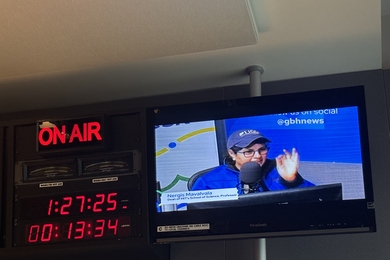
On GBH’s new show The Curiosity Desk, MIT LIGO researchers revel in the beauties of fundamental discovery science and MIT astronomers talk planetary defense.
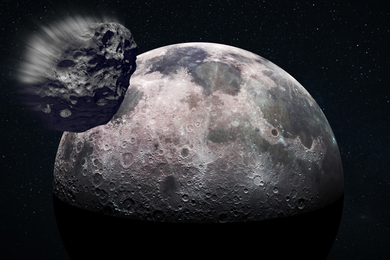
MIT astronomers are developing a new way to detect, monitor, and mitigate the threats posed by smaller asteroids to our critical space infrastructure.

Professor Jesse Thaler describes a vision for a two-way bridge between artificial intelligence and the mathematical and physical sciences — one that promises to advance both.
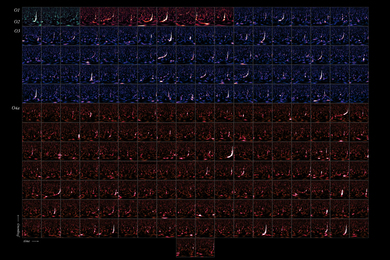
The latest crop of space-time wobbles includes a variety of heavy, fast-spinning, and lopsided colliding black holes.

In his 10 years at MIT, Loureiro helped illuminate the physics occurring at the center of fusion vacuum chambers and at the edges of the universe.
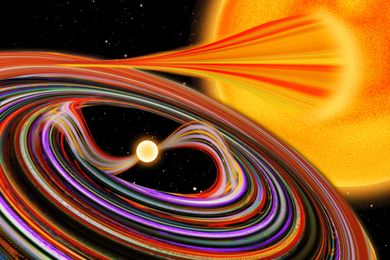
X-ray observations reveal surprising features of the dying star’s most energetic environment.
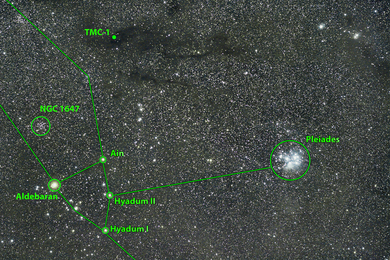
The discovery will help researchers understand how chemicals form and change before stars and planets are born.
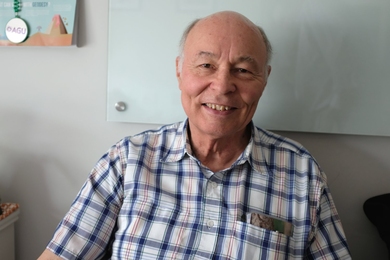
Longtime research scientist who served as associate director and interim director helped guide Haystack to decades of influential leadership in the development and refinement of the VLBI technique.

A proposed telescope made of thousands of tiny, identical satellites will work to reveal low-frequency radio waves in space.
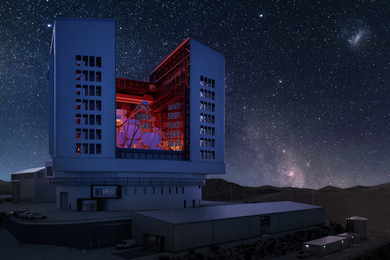
The major public-private partnership is expected to strengthen MIT research and US leadership in astronomy and engineering.
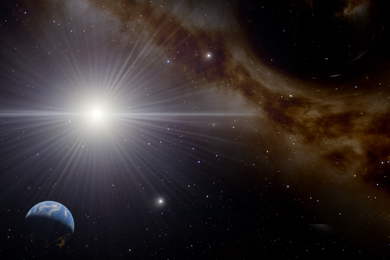
If a new proposal by MIT physicists bears out, the recent detection of a record-setting neutrino could be the first evidence of elusive Hawking radiation.
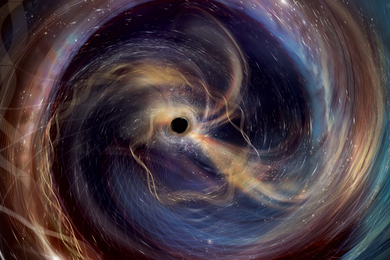
LIGO, Virgo, and KAGRA celebrate the anniversary of the first detection of gravitational waves and announce verification of Stephen Hawking’s black hole area theorem.
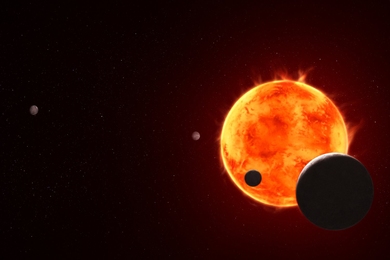
Astronomers led by EAPS postdoc Ana Glidden ruled out several atmospheric scenarios for the planet, narrowing ideas of what habitability there might look like.
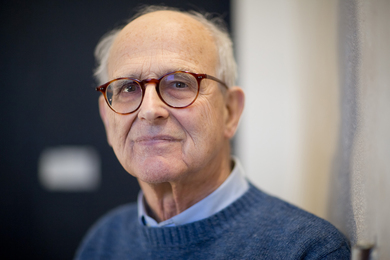
The longtime MIT professor shared a Nobel Prize for his role in developing the LIGO observatory and detecting gravitational waves.