
MIT spinout turns plastic waste into resilient building materials
Atlas Building Composites is commercializing MIT research to turn plastic waste into parts for buildings and other infrastructure.
Atlas Building Composites is commercializing MIT research to turn plastic waste into parts for buildings and other infrastructure.

The new framework could streamline the design process of robotic grippers or aerospace components that exhibit complex behaviors found in nature.
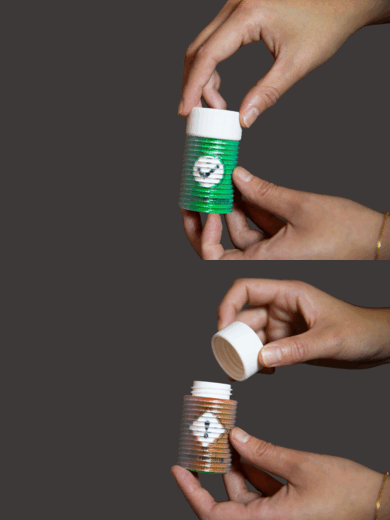
The “ShiftLens” design and fabrication system creates objects that change their surface appearance based on user interactions, without any electronics.
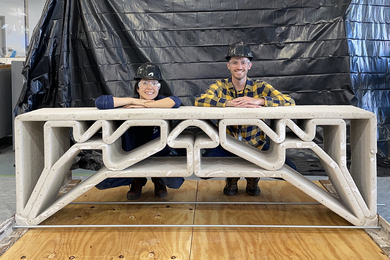
MIT researchers developed a framework that folds a printer’s real-world limits into the optimization, while revealing that better hardware could sharply reduce material use.
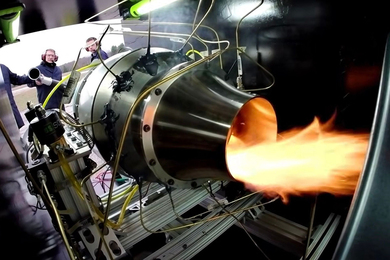
MIT students designed, built, and tested a jet engine with AI copilots, assessing AI’s usefulness in developing high-performance aerospace systems.
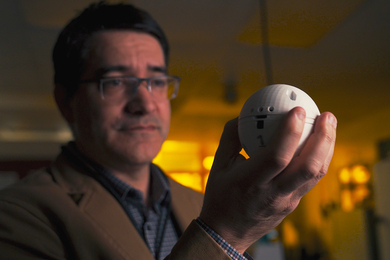
The “TOSSIT” device, developed at MIT Lincoln Laboratory, can warn service members and first responders of dangerous vapors and aerosols.
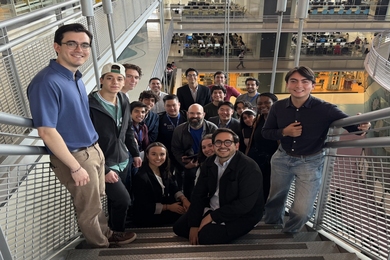
MIT and Tec de Monterrey will expand FrED curriculum to universities across Mexico.
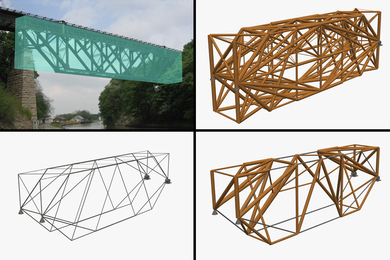
MIT researchers developed an approach for generating more buildable structures, bridging the gap between optimized design and real-world construction.
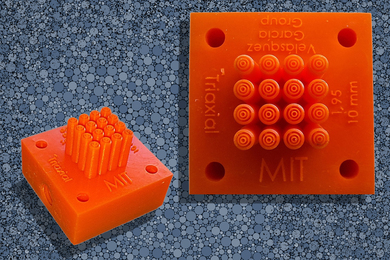
The cost-effective devices, which can be built in hours, leverage electrospray emitter technology to efficiently produce three-layered particles at scale.
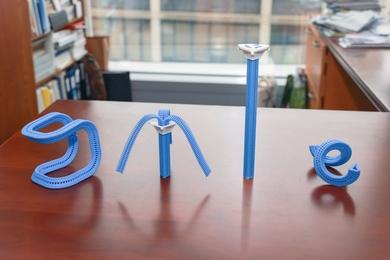
An old patent from MIT Professor Bill Freeman inspired the new “Y-zipper,” a three-sided fastener that snaps gear, robots, and art into shape at the push of a button.
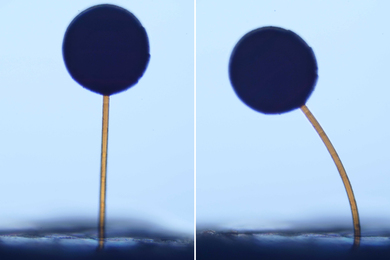
MIT researchers’ new fabrication technique can produce soft, microscopic structures with magnetically activated moving parts.
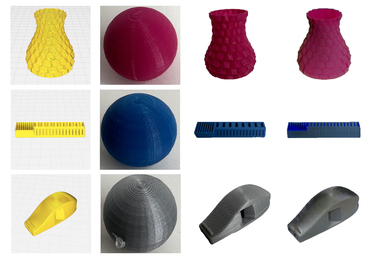
By quickly generating aesthetically accurate previews of fabricated objects, the VisiPrint system could make prototyping faster and less wasteful.
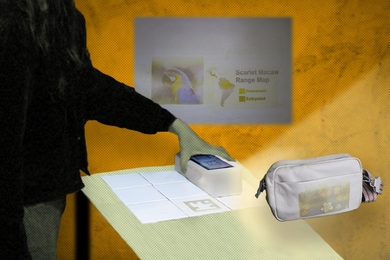
The portable “ChromoLCD” device combines LCD and LED lighting to customize high-quality designs onto things like shirts and whiteboards.
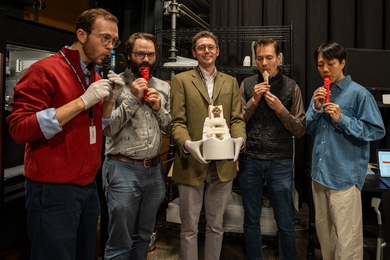
Through an interdisciplinary collaboration between MIT and the Museum of Fine Arts, Boston, researchers are creating playable physical and synthesized replicas.
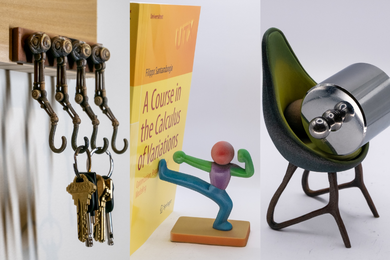
To help generative AI models create durable, real-world accessories and decor, the PhysiOpt system runs physics simulations and makes subtle tweaks to its 3D blueprints.