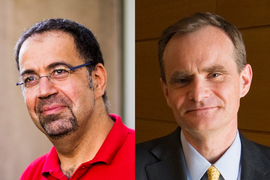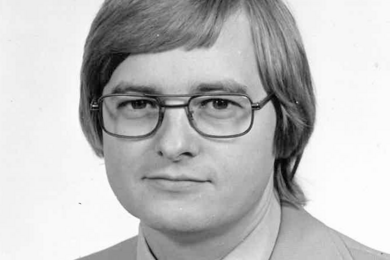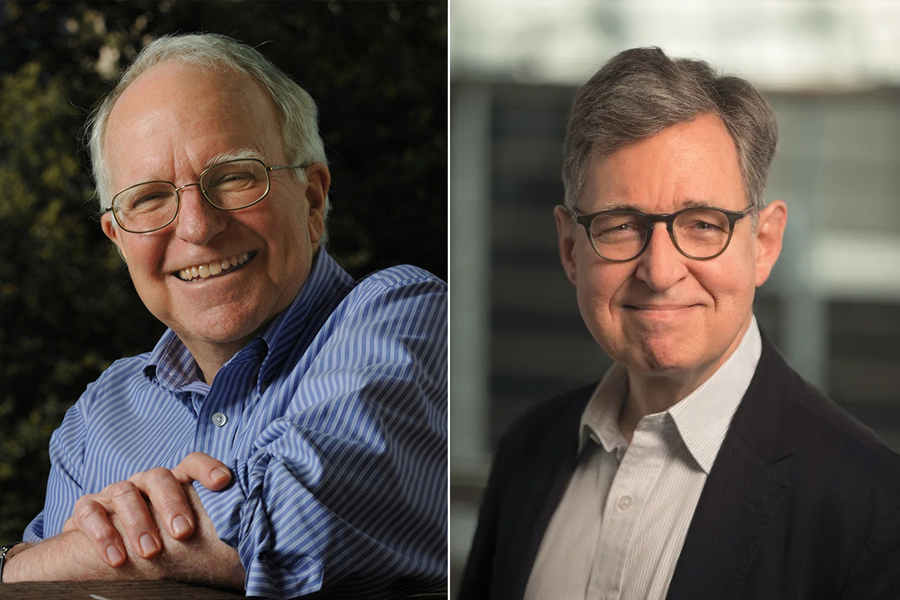
Robert E. Hall PhD ’67 and Michael Woodford PhD ’83, scholars who both earned their doctorates at MIT, have been awarded the 2026 Sveriges Riksbank Prize in Economic Sciences in Memory of Alfred Nobel.
Hall, a professor at Stanford University, and Woodford, a professor at Columbia University, were recognized for work that helped revitalize ideas about how government policy can spur growth to help end economic downturns. The Nobel citation describes their research as contributing to “new macroeconomic models that have significantly improved our ability to implement effective stabilisation policy.”
Both scholars helped integrate microeconomic analysis into macroeconomic models. In Hall’s case, the Nobel committee particularly cited research he conducted in the late 1970s shedding new light on economic expectations and household consumption. The committee also spotlighted Woodford’s construction of a comprehensive and influential macroeconomic model that was built on microeconomic foundations and introduced in his 2003 book, “Interest and Prices: Foundations of a Theory of Monetary Policy.”
The work of both scholars helped update models for intervention during economic crises, based on the ideas of John Maynard Keynes, which had worked many times in the 20th century but encountered newfound difficulties adapting to the conditions of the 1970s. So-called New Keynesian models used for economic stabilization today are a result of both economists’ research, the citation noted.
Hall is the Robert and Carole McNeil Joint Senior Fellow at the Hoover Institution and Professor in the Department of Economics at Stanford University. He received his BA in economics from the University of California at Berkeley before earning his PhD from MIT. He also served as an MIT faculty member in the 1970s.
Woodford is the the John Bates Clark Professor of Political Economy at Columbia University. He received a BA from the University of Chicago and a JD from Yale University Law School prior to receiving his PhD from MIT.
Remarkably, Hall becomes the fifth former doctoral student principally advised by MIT economist Robert M. Solow to earn the Nobel Prize in economics. The others are George Akerlof PhD ’66, Peter Diamond PhD ’63, William Nordhaus PhD ’67, and Joseph Stiglitz PhD ’67, all of whom had Solow as their principal advisor in MIT’s graduate program. Additionally, MIT professor of biology H. Robert Horvitz ’68, a Nobel laureate in 2002 in the category of physiology or medicine, wrote his undergraduate thesis in economics under the direction of Solow. In 1987, Solow received the Nobel Prize himself.
Woodford did his doctoral work under the primary supervision of Timothy Kehoe, now of the University of Minnesota — although Woodford does thank Solow in the first paragraph of his doctoral thesis, for helping him “distinguish important problems from exercises of merely technical interest.”
There are now 17 MIT alumni who have won the Nobel Prize in economics. Previously, 10 people have won the award while serving on the MIT faculty, and 10 former faculty have also been named recipients.