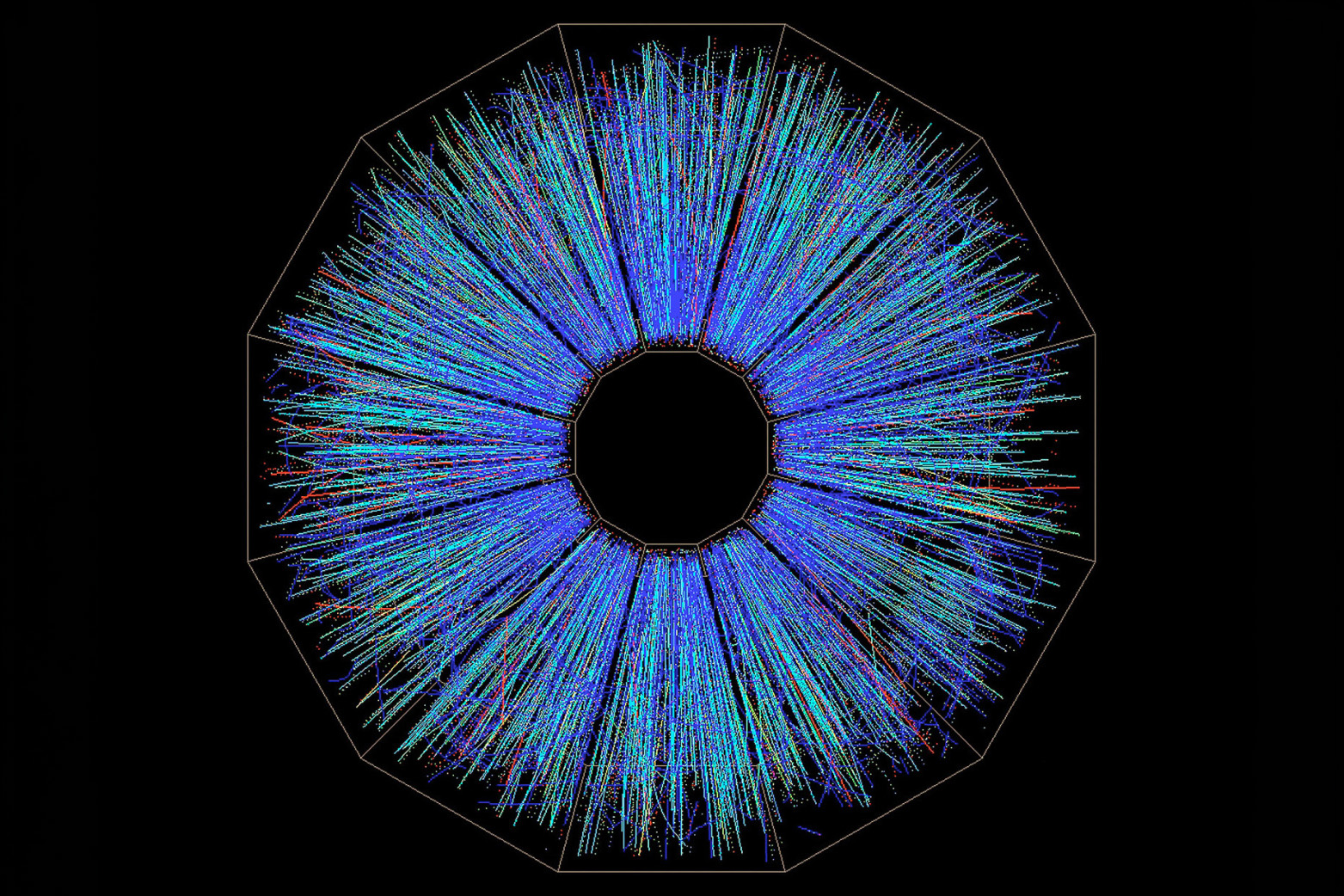
In the first fraction of a second following the Big Bang, matter existed as a trillion-degree plasma of quarks and gluons — subatomic particles that zinged around at close to the speed of light. This roiling soup lasted for just a few microseconds, before the particles coalesced into more stable protons and neutrons.
To study this primordial fluid, scientists recreate quark-gluon plasma in large particle accelerators, where ions are smashed together at close to the speed of light. These collisions create droplets of plasma roughly the size of an atomic nucleus, that exist for only tens of septillionths of a second.
One way scientists study this plasma is by tracking other particles, such as heavy quarks, that are not part of the plasma but happen to move through it. The way a heavy particle moves through a fluid should tell something about the microscopic structure of the fluid itself. This general relationship was established famously by physicist Albert Einstein in 1905.
But in such extreme conditions, where particles are moving at close to the speed of light, something in Einstein’s theory starts to break down; there are interactions within the plasma that the theory can’t quite capture.
Now, physicists at MIT and the University of California at Santa Barbara (UCSB) have taken up where Einstein’s theory left off. They have worked out a theory that predicts how a relativistic particle, moving at close to the speed of light, is likely to be pushed and pulled by a fluid as it flies through it.
The researchers envision that the new theory could be applied to predict how a heavy quark will move through quark-gluon plasma. Such predictions could then be compared to experiments to characterize the microscopic structure of quark-gluon plasma, and what kind of fluid must have existed in the universe’s first moments.
“Our result reveals a new source of information carried by heavy quarks in rare, unusually large changes in their motion,” says Jean Du Plessis, a graduate student in MIT’s Center for Theoretical Physics – a Leinweber Institute. “How often those large changes occur depends on the microscopic nature of the plasma, raising the possibility that they could provide a new way to learn what the quark-gluon plasma is actually like inside.”
Du Plessis and Bruno Scheihing-Hitschfeld of the Kavli Institute for Theoretical Physics at UCSB report their findings today in Physical Review Letters.
A path from pollen
In 1905, Einstein developed a theory to describe a particle’s motion through fluid and how that motion can reveal the fluid’s microscopic structure. His theory was inspired by the botanist Robert Brown. In 1827, Brown observed a surprising phenomenon: Grains of pollen appeared to randomly jiggle and swirl when suspended in seemingly still water. This curious jittering of particles in fluid was later named “Brownian motion.”
Einstein’s 1905 theory showed that Brownian motion was a product of invisible, microscopic forces within the fluid. A particle’s motion is a balance between the drag that the fluid exerts on the particle to slow it down, and the random kicks within the fluid that keep the particle moving. These random kicks, Einstein argued, must come from microscopic forces within the fluid, exerted by none other than the atoms and molecules that make up the fluid. The energy of these microscopic particles can add up to kick and jostle larger particles.
Since he first published his theory, scientists have applied Einstein’s explanation of Brownian motion to characterize a host of fluids, including quark-gluon plasma. Like most other fluids, it was assumed that a particle moving through quark-gluon plasma should experience a similar balance of microscopic kicks as a grain of pollen moving through water.
This balance is represented by a bell-shaped probability distribution, where a particle is most likely to experience medium forces of kicks (the highest point of the bell), and an equally low probability of the most extreme kicks (the tail ends of the bell), as the particle moves through and eventually settles into a fluid.
“Einstein showed that the drag and the random kicks must balance in just the right way for a particle eventually to come to the same temperature as its surroundings,” Du Plessis explains. “For the types of fluids he was thinking about, he was correct. But for particles that are moving at relativistic velocities, this relationship breaks down. And we’ve known for 20 years that something is missing. So we have to go beyond the work that Einstein did.”
Kick speed
In their new study, Du Plessis and Scheihing-Hitschfeld calculated the forces that a heavy quark would likely experience if it flew through a fluid at relativistic speeds, close to the speed of light. They did so by carrying out calculations of the strong nuclear force, which is the fundamental force that pulls together quarks and gluons.
The team started with a scenario of a relativistic heavy quark flying through a gas of weakly interacting quarks and gluons. The weak interactions made this a manageable starting point for their calculations.
For this starting scenario, they calculated the heavy quark’s strong nuclear force and how much its momentum is likely to change as it moves through the gas of quarks and gluons. This calculation produced a curve, or a probability distribution of the quark’s changes in momentum. The same curve can represent the quark’s probability of being kicked with various force; stronger kicks cause bigger changes to the quark’s momentum.
The curve that the researchers calculated was bell-shaped, similar to what Einstein found with other fluids, only for small kicks. And, unlike Einstein’s bell-shaped curve, what the team found showed a tilt for heavy quarks moving at relativistic speeds. The tails at either end of the curve were uneven, and revealed a surprising imbalance in the kinds of kicks that a heavy quark would experience.
“The usual Brownian picture assumes that large kicks become exceedingly rare,” Du Plessis says. “For heavy quarks, however, these rare kicks are more common than the bell curve predicts, and are not equally likely in opposite directions: A large kick that slows the quark down more than expected from drag is more likely than an equally large kick that leaves it moving faster than expected.”
The team carried out the same calculation in plasmas made up of different particles. They found that the same tilted curve applies, regardless of the makeup of the plasma. Furthermore, they found that this same structure was already hiding in an earlier calculation in a strongly coupled plasma, despite the differences in the microscopic physics.
“This is the first time that this seemingly universal structure was realized and really formalized,” Du Plessis says. “This gives a concrete path forward for how to better understand the quark-gluon plasma, using heavy quarks.”
In terms of what this means for the universe’s first fluid, Du Plessis says that primordial quark-gluon plasma is likely “more strongly interacting than this Brownian motion way of modeling it would suggest. It’s more like a liquid and less like a gas.”
This research was supported, in part, by the Office of Nuclear Physics in the U.S. Department of Energy’s Office of Science, the U.S. National Science Foundation, and the Simons Foundation.