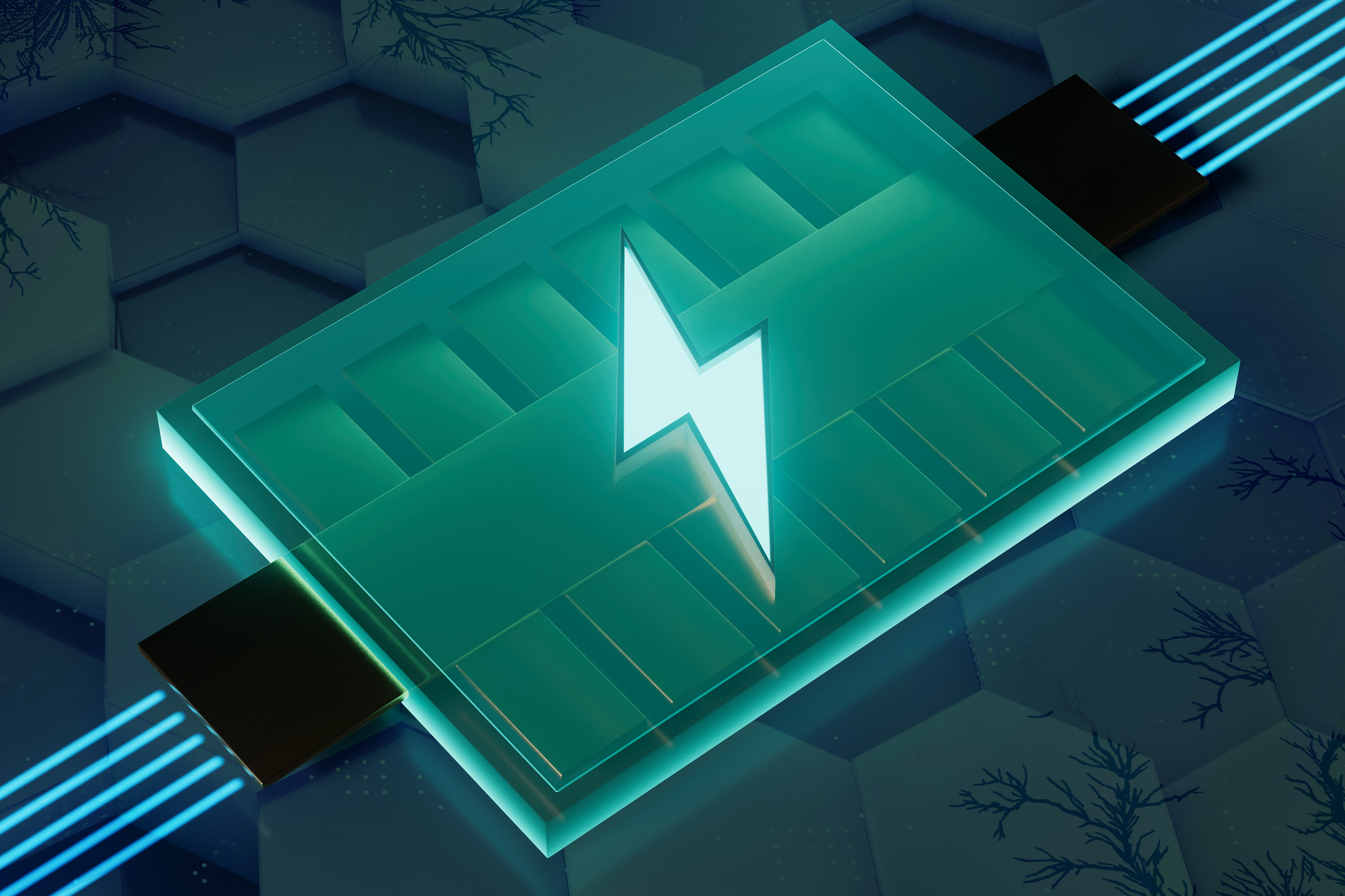
Next generation batteries that use new electrolyte materials could achieve far higher energy density than today’s lithium-ion batteries, without many of the safety concerns. But advanced batteries, such as those that use solid or almost-solid electrolytes, have been plagued by the formation of tiny spikes of lithium metal called dendrites that cause the batteries to lose efficiency and fail.
Exactly how those dendrites form is still up for debate. While the interface between the battery’s electrolyte and electrodes has been the focus of most research, another culprit is the boundary where two grains of electrolyte in a solid material meet. Researchers know these boundaries can seed dendrites within electrolytes, although the effects have been difficult to study.
Now researchers at MIT and the Technical University of Munich have uncovered why such boundaries can lead to dendrites: Hidden electrical imbalances across the boundaries affect how the electrolyte conducts electrical charges, which influences how the ions and electrons move through the material during battery operation. In a paper published today in Nature Nanotechnology, the researchers characterized the electrical and chemical behavior of the boundaries and showed that adjusting how the electrolyte is processed enhances the movement of ions while reducing electron leakage. This adjustment can increase critical current density by more than 300 percent, which could enable solid-state batteries that charge faster and last longer.
“Grain boundaries are like the weather: Everyone talks about it, but nobody does anything about it,” says senior author Harry Tuller, a professor in MIT’s Department of Materials Science and Engineering. “In this paper, we’ve decided to do something about grain boundaries, and by doing something we’ve shown improved performance and demonstrated the importance of grain boundaries more broadly.”
Joining Tuller on the paper are first author Hyunwon Chu PhD ’25; former MIT professor Jennifer Rupp, the Electrochemical Material Professor at the Technical University of Munich (TUM), who led the study and is the corresponding author; TUM researchers Waldemar Kaiser, Lukas Wolz, Fran Kurnia, Kun Joong Kim, David Egger, and Johanna Eichhorn; Thomas Defferriere PhD ’22; Willis O’Leary PhD ’24; and University of Antwerp researchers Proloy Nandi, Johan Verbeeck, Sara Bals, and Thomas Altantzis.
Investigating grain boundaries
Rupp’s research group, which moved from MIT to TUM during this research, has spent years studying the behavior of next-generation electrolyte materials. Electrolytes in solid-state batteries are made of many tiny crystals of material packed together.
“What we call a grain, like a grain of salt, is actually a single crystal, but it might only be on the order of 1 micron in size,” explains Tuller. “Under high temperature processes, the best materials essentially consolidate to be void or pore-free and can be nearly 100 percent dense, but each of those crystallites is separated from its neighbor by a grain boundary.”
Solid-state battery researchers have increasingly focused on grain boundaries as the source of the lithium metal dendrites that cause them to short circuit. It’s been suspected that grain boundaries have different chemical and electrical properties from the grains, which interact with the ions and electrons shuttling between electrodes during battery charging and discharging. However, the exact mechanisms by which the boundaries slowed the ions down, leaked electrons, and led to dendrites was unknown.
“Grain boundaries are like defects,” Tuller says. “The boundaries have a higher level of defects than in the grains themselves, and generally that means as carriers of charge approach the boundary, whether electrons or ions, there’s some kind of blockage to overcome.”
To better understand that interference, the researchers developed a model to explain how local electrical imbalances at grain boundaries change the movement of lithium ions and electronic charge carriers. They tested the model in a common solid electrolyte material called lithium lanthanum zirconate, or LLZO, using techniques including electron microscopy, machine learning modeling, and electrochemical impedance spectroscopy, which measures how easily a charge moves through a material.
They found the cores of the boundaries carry a local electrical charge, building up local electric fields that lead to enhanced ionic resistance while causing a build-up of electrons in the boundary region, where they can reduce lithium ions, leading to lithium metal dendrite formation.
“For the last 30 years, the world has been dominated by lithium-ion batteries, but there is a growing recognition that other battery types are needed for batteries used in a variety of uses,” Rupp explains. “This work gives us the fundamental understanding of the space charge interface at the grain boundary. If understood properly, we can come up with engineering concepts to increase cycle life, transference of ions over electrons at these interfaces, and ultimately a better battery.”
Better battery materials
The researchers used their observations to adjust the material processing conditions of the LLZO electrolyte material and minimize the negative charges at the boundaries, finding they could ease the movement of lithium ions and reduce the leakage of electrons.
The modifications allowed them to create an electrolyte that had a critical current density more than 300 percent higher than a baseline sample. Higher current density allows for faster charging and discharging. It should also delay short circuiting to extend the life of batteries.
“Fires are currently a huge issue in the battery industry,” Rupp says. “By showing how to engineer these space charges in a controlled way, which is new in the field, we can have a strong impact on safety. It’s a new way to turn up the notch and get these batteries to charge faster and last longer before they break.”
The findings, along with the researchers’ engineering work, present a roadmap for battery researchers to accelerate the development of high-performance, longer lasting solid-state batteries.
“We showed we can control the initiation of these dendrites to maximize solid state batteries’ high performance,” Chu says. “In this paper, we started with a theory for how these dendrites form, then we did the material characterization to support that theory, then we did the engineering to apply the findings and actually improve battery performance.”
The work was supported, in part, by the National Science Foundation and the U.S. Department of Homeland Security.