The following is from a blog posting by Karina Pikhard ’09 on the Alumni Association's Slice of MIT blog.
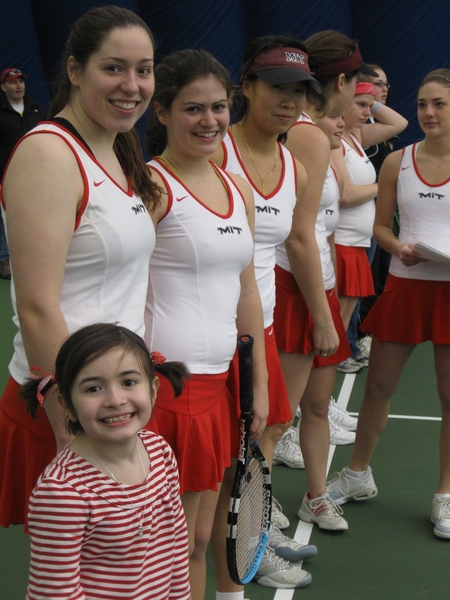
In the fall of 2008, the newest member of the MIT women’s tennis squad — “Chickaroo” was her nickname — stood at 3-foot-something. At only 8 years old, she preferred to bounce around the court rather than obey the instructions of Coach Carol Matsuzaki ’95, ’96. Before a match, Chickaroo would stand in the center of the team huddle, make her meanest face, and growl, “We’re gonna get ‘em!”
“We’re gonna get ‘em!” is also the cheer that we all give Caroline when we visit her at her second home, the Dana-Farber Cancer Institute. There, the tennis team gathers around Caroline and participates in her favorite waiting-room crafts — coloring, painting, and playing with glitter and pipe cleaners. Her parents are exhausted from the day’s eight-hour long stay, with visits to the oncologist, neurologist, endocrinologist, and ophthalmologist, among others. All we can do is offer a little comfort simply by being present. We are humbled by the unspeakable fact that no matter how exhausted we feel after a day of hard-fought tennis matches, it is simply no match for the Hamiltons, who are fighting the battle of their lives.
Learn more about Caroline and the Friends of Jaclyn program, which pairs young brain tumor patients with varsity sports teams at universities across the U.S. on the Slice of MIT post.
In the fall of 2008, the newest member of the MIT women’s tennis squad — “Chickaroo” was her nickname — stood at 3-foot-something. At only 8 years old, she preferred to bounce around the court rather than obey the instructions of Coach Carol Matsuzaki ’95, ’96. Before a match, Chickaroo would stand in the center of the team huddle, make her meanest face, and growl, “We’re gonna get ‘em!”
“We’re gonna get ‘em!” is also the cheer that we all give Caroline when we visit her at her second home, the Dana-Farber Cancer Institute. There, the tennis team gathers around Caroline and participates in her favorite waiting-room crafts — coloring, painting, and playing with glitter and pipe cleaners. Her parents are exhausted from the day’s eight-hour long stay, with visits to the oncologist, neurologist, endocrinologist, and ophthalmologist, among others. All we can do is offer a little comfort simply by being present. We are humbled by the unspeakable fact that no matter how exhausted we feel after a day of hard-fought tennis matches, it is simply no match for the Hamiltons, who are fighting the battle of their lives.
Learn more about Caroline and the Friends of Jaclyn program, which pairs young brain tumor patients with varsity sports teams at universities across the U.S. on the Slice of MIT post.