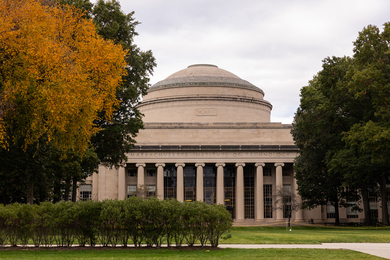
Eight members of the MIT community are among the 210 new Fellows and 19 new Foreign Honorary Members recently elected to the American Academy of Arts and Sciences.
Established in 1780 by founders of the nation, the academy undertakes studies of complex and emerging problems. Current projects focus on science, technology and global security; social policy and American institutions; the humanities and culture; and education. The academy's membership of scholars and practitioners from many disciplines and professions gives it a unique capacity to conduct a wide range of interdisciplinary, long-term policy research.
Since the academy's founding, its fellows have included George Washington and Benjamin Franklin in the eighteenth century, Daniel Webster and Ralph Waldo Emerson in the nineteenth, and Albert Einstein and Winston Churchill in the twentieth. The current membership includes more than 250 Nobel laureates and more than 60 Pulitzer Prize winners.
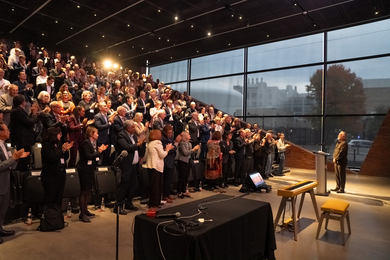
The academy will welcome this year's new class at its annual induction ceremony in October at its Cambridge, Mass. headquarters.
New members of the American Academy of Arts and Sciences from MIT are:
- Esther Duflo, the Abdul Latif Jameel Professor of Poverty Alleviation and Development Economics
- Robert Gibbons, the Sloan Distinguished Professor of Organizational Economics and Strategy, MIT Sloan School of Management
- Bradford Hager, the Cecil and Ida Green Professor of Earth Sciences
- Nancy Kanwisher, the Ellen Swallow Richards Professor of Cognitive Neuroscience
- Mehran Kardar, professor of physics
- Dana Mead, chairman of the MIT Corporation
- Michael Sipser, professor of mathematics and head of the Department of Mathematics
- Edwin Lorimer Thomas, the Morris Cohen Professor of Materials Science and Engineering and head of the Department of Materials Science and Engineering.
A version of this article appeared in MIT Tech Talk on April 29, 2009 (download PDF).