The enhanced capabilities of a new global satellite communications (SATCOM) system were successfully tested recently by MIT Lincoln Laboratory, representing a major step forward in improving communications among U.S. Department of Defense commands around the world.
In March, Lincoln Laboratory completed its portion of the on-orbit testing of the first Wideband Global Satellite (WGS) communications system, a constellation of geosynchronous satellites orbiting 22,300 miles above the equator. The system provides worldwide high-capacity military satellite communication capabilities.Â
The WGS system improves upon the X-band capability (between 7 and 9 GHz) of the current Defense Satellite Communications system to include "Ka-band" service (30 GHz ground to satellite, 20 GHz satellite to ground.)
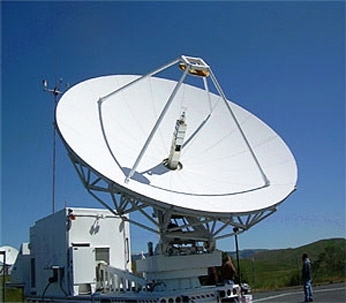
These sophisticated new broadcast capabilities were tested in orbit by a ground-based Large Aperture Ka-Band Test Terminal (LAKaTT), developed by Lincoln Laboratory.
The terminal and its 20-foot antenna, which can transmit up to six carriers simultaneously, were created by the Lincoln Laboratory team out of a refurbished surplus satellite communications terminal. The heavily instrumented terminal can operate under remote computer control.
Just before the launch of the first WGS satellite in October 2007, the LAKaTT was deployed to Dublin, Calif., to test the expanded two-way Ka-band capability of the WGS system.
"The launch and on-orbit testing activities have been superb and we're really excited about having this capability in the hands of our military personnel," said Col. Don Robbins, Wideband SATCOM Group Commander.