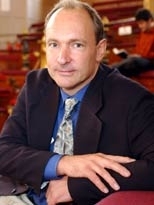
Internet pioneer Timothy Berners-Lee has been named the 3Com Founders Professor of Engineering in the School of Engineering, with a joint appointment in the Department of Electrical Engineering and Computer Science, School of Engineering Dean Subra Suresh announced this week.
Berners-Lee is widely recognized with having created the World Wide Web. He proposed his concept for the Web in 1989 while at the European Organization for Nuclear Research (CERN), launched it on the Internet in 1991 and continued to refine its design through 1993. In 1994, the British native joined the Laboratory for Computer Science at MIT to be director of the World Wide Web Consortium (W3C), an open, international forum that develops standards for the Web.
Suresh said that as a member of the faculty, Berners-Lee will focus his research efforts on the social and technical aspects of collaborative applications running on large-scale networks like the Web, and on the Semantic Web-an extension of the Web in which the semantics of information and services on the Web is captured. In addition to research activities in these areas and on other extensions to the World Wide Web, Berners-Lee also plans to develop, jointly with several other institutions around the world, new curricular material for Web Science, which will involve close interactions between computer science, the social sciences and technology application deployment.
Berners-Lee has received many honors for his work, including honorary degrees from Oxford, Columbia and eight other universities; being named a Fellow of the Royal Society, the American Academy of Arts and Sciences, the American Philosophical Society and a Foreign Associate of the National Academy of Engineering; being honored by the Queen, and holding the OBE (Officer of the Order of the British Empire), the KBE (Knight Commander of the Order of the British Empire) and the OM (Order of Merit limited to the Queen and 24 other members, the highest civilian honor in Great Britain); and winning the Japan Prize, the inaugural Millennium Technology Prize, the NAE's Charles Stark Draper Prize, a MacArthur Fellowship, and the Royal Academy of Engineering's Whittle Medal.