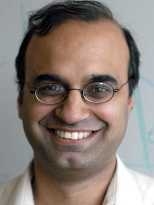
MIT physicist Deepto Chakrabarty and two other scientists will share this year's Bruno Rossi Prize for their pioneering work on understanding the exotic environment around fast-spinning neutron stars, where matter can whirl about at nearly light speed and where space itself is warped.
The prize, named for the late MIT Institute Professor Emeritus, is the top award given each year by the High Energy Astrophysics Division of the American Astronomical Society (AAS). Announced earlier this month, the prize will be officially awarded at an AAS meeting next January in Seattle.
"Bruno Rossi was a giant at MIT, and as an MIT professor, I am humbled to receive an award named in his honor," Chakrabarty said.
Chakrabarty, an associate professor of physics at MIT and a researcher at MIT's Kavli Institute for Astrophysics and Space Research, shares the prize with Tod Strohmayer of the NASA Goddard Space Flight Center and Rudy Wijnands of the University of Amsterdam.
Their work, done both independently and in collaboration, has been described as a breakthrough in interpreting the complex signals emitted as X-ray light from millisecond pulsars. A millisecond pulsar is a type of fast-spinning neutron star in a binary system with an ordinary star. Gas pulled away from the surface of the companion star crashes onto the neutron star, spinning it up to rotation rates of hundreds of revolutions per second.
These scientists have revealed that oscillations in the emitted X-ray light can be used to measure the pulsar's spin rate and other key parameters. Their observations were made with NASA's Rossi X-ray Timing Explorer, which marks its 10th year in orbit this month.
"The Rossi Explorer is a powerful tool to probe the environs of black holes and neutron stars," Chakrabarty said. "It has been thrilling to join my colleagues in so many discoveries."
Chakrabarty is an expert on millisecond pulsars. He credits his MIT colleagues and collaborators, especially research scientist Edward Morgan, with making his discoveries possible.
A version of this article appeared in MIT Tech Talk on January 25, 2006 (download PDF).