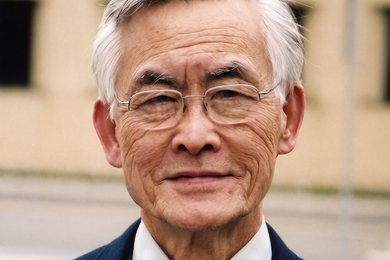
Robert Langer, the Germeshausen Professor of Chemical and Biomedical Engineering, has been awarded the Charles F. Kettering Prize, one of three awards given annually by the General Motors Cancer Research Foundation. The $250,000 prize recognizes the most outstanding recent contribution to the diagnosis or treatment of cancer.
Langer was cited for his major contributions to the development of sustained-release drug delivery systems for the treatment of cancer.
"I went into cancer research because I had always drawn a lot of satisfaction from helping people," Langer said. "I wanted to use my science and engineering background in a way that would help people live longer and healthier lives."
Langer's achievements have had a profound impact on the field of cancer research. His accomplishments are also unique in that he entered the field with a Ph.D. in chemical engineering when he teamed with cancer researcher Judah Folkman at Children's Hospital in Boston in 1974. At that time, the scientific community believed that only small molecules could pass through a plastic delivery system in a controlled manner.
In the 1970s, Langer went on to develop polymer materials that allowed the large molecules of a protein to pass through membranes in a controlled manner to inhibit angiogenesis, the process by which tumors recruit blood vessels. Blocking angiogenesis is critical in fighting cancer because the new blood vessels allow tumor cells to escape into the circulation and lodge in other organs.
In addition, this discovery led to his work on biodegradable polymers that pharmaceutical companies later used for treating men with advanced prostate cancer. Langer's subsequent research on biodegradable polymers with Henry Brem of the Johns Hopkins University School of Medicine led to new treatments for patients with brain cancer.
"In a general sense, I think the significance of our discovery is that it opened up the field of controlled drug delivery systems, allowing for treatments with molecules of varying sizes that could be delivered over a broad range of time--from days to months," Langer said. "Specific to cancer research, I think it helped in three areas: the angiogenesis field, the development of new treatments, and the introduction of local chemotherapies."
"Receiving the Kettering Prize is an enormous honor for me," Langer added. "I'm very proud that this award is a symbol of recognition for the impact biomedical engineering has had on the fight against cancer. And I hope it inspires others to pursue a career in cancer research."
GM will present the prize to Langer during an awards ceremony at the U.S. Department of State on Wednesday, June 9. The ceremony is part of the GMCRF Annual Scientific Conference. Langer will give a lecture describing his research.
A version of this article appeared in MIT Tech Talk on June 2, 2004 (download PDF).