Skip to content ↓

Students create sculptures that melt in your mouth

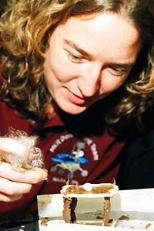
Emily Crapar, an MIT graduate student in aeronautics and astronautics, works on making a tiny chocolate table.
Caption:
Emily Crapar, an MIT graduate student in aeronautics and astronautics, works on making a tiny chocolate table.
Credits:
Photo / Laura Wulf
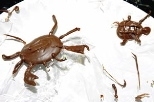
"They're cute and I like eating crabs. I thought eating chocolate crabs would be good, too," said Shanshan Mou, a senior in biology at Harvard.
Caption:
"They're cute and I like eating crabs. I thought eating chocolate crabs would be good, too," said Shanshan Mou, a senior in biology at Harvard.
Credits:
Photo / Laura Wulf

Freshman Ellis Langford carefully stirred the melting chocolate chips before placing them in the microwave for another 30 seconds or so.

"We've learned to temper the chocolate with gradual, even heating, so that it cools into a stable form," explained Susan Born (S.B. 1998 in chemical engineering), a member of the Lab for Chocolate Science, a student club that selected its name for the acronym. Club members enjoyed claiming to be members of the LCS until, Born pointed out, the Lab for Computer Science announced its new name and acronym, the Computer Science and Artificial Inteilligence Lab (CSAIL).

Born and Langford were managing the club's IAP course, "Chocolate Sculpture," held Jan. 26 in the Experimental Study Group's kitchen on the sixth floor of Building 24.

The course drew about 50 students from MIT, Wellesley and Harvard. "Everybody loves chocolate," said Sloan School graduate student Joh Klein as she waited in line for her cup of melted chocolate.

The sculptures were tiny, and most had a short life. Each student dripped chocolate or squeezed it through plastic wrap onto wax paper to form whatever shapes came to mind--rings, hearts, circles, blobs, letters or turtles and crabs--before eating them.

Related Links

Related Topics

More MIT News

Globular blue and white orbs "examining" single-stranded RNA products and marking them with green checks or red x's

Why are some bacterial genes high in purines?

In certain species of bacteria, the answer lies in shielding RNA transcripts from a quality-control factor called Rho. Understanding the requirements for expressible sequences is critical for expression engineering of therapeutic agents.

Read full story

Rich Nielsen, Volha Charnysh, Kevin Dorst, and Emily Richmond Pollock seated at a table, talking

Building a scholarly community

The SHASS Faculty Fellows Program, administered by the MIT Human Insight Collaborative, is fostering new research projects and creating space for supportive and interdisciplinary discussion.

Read full story