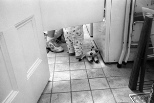
"Family: Scene, Yet Unseen," an exhibition of black and white photographs by B.D. Colen, a lecturer in the Program in Writing and Humanistic Studies, is the inaugural show in a gallery on the first floor of the new Sidney-Pacific graduate residence.
"I want people to feel the shock of recognition when they look at the photographs I've made of people they've never met," writes Colen, recipient of a 1984 Pulitzer Prize for news reporting and author of nine books on health and medicine. "While the people in the photos may be strangers to the viewers, the situations photographed are those that make up the fabric of all our lives."
Sidney-Pacific encourages MIT-affiliated artists to share their works in this gallery space which includes 12 lockable display cases (internal dimensions are 28" wide by 41" high by 2" deep).
To get into the gallery, ask at Sidney-Pacific's front desk. An opening reception for "Family: Scene, Yet Unseen" will be held tonight from 8:30-10 p.m. The show is on view through May 10. For more information, e-mail Andrew Chen at achen@mit.edu.
A version of this article appeared in MIT Tech Talk on April 9, 2003.