Skip to content ↓

Engineers moonlight as artists for "Collision 3 in Super 3-D"

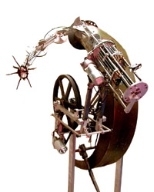
"Dirty Red" is a robotic sculptural amalgamation of motors, rusty metal and "artificial-unintelligence," built by electrical engineering and computer science graduate student Aaron Edsinger. The sculpture will be featured in an installation created in collaboration with sound artist Jeff Weber, a research engineer in the AI Lab.
Caption:
"Dirty Red" is a robotic sculptural amalgamation of motors, rusty metal and "artificial-unintelligence," built by electrical engineering and computer science graduate student Aaron Edsinger. The sculpture will be featured in an installation created in collaboration with sound artist Jeff Weber, a research engineer in the AI Lab.

What happens when art collides with technology? "Collision 3 in Super 3-D," an MIT Museum event developed by a student group at MIT.

"The art in the Collision shows appeals to people on so many different levels," said Dan Paluska, co-curator and founder of the ATat (Arts and Technology at Tech) student group.

"I think many people are frustrated by the sterility of untouchable paintings in whitewashed galleries. Most of the technology used in the Collision shows is technology that brings the art closer to the viewer. It allows them to touch, to affect, to experience," said Paluska.

"Collision 3 in Super 3-D," the third such event developed by ATat, will be held Saturday and Sunday, June 1-2, from noon to 5:00 p.m. The program will feature many forms of technological art, including kinetic, light and robotic sculpture; computer graphics and games. In addition, local artists will give special performances. Participating artists include Henry Kaufman, Holly Gates, John Powell, Ryan McKinley, Ben Piper, Casey Reas, Fran Trainor, Brian Knep, Jonathan Bachrach, David Webber, Margaret Weigel, Jeff Weber and Aaron Edsinger.

Admission to the event is free with the cost of museum admission.

A version of this article appeared in MIT Tech Talk on May 22, 2002.
Related Topics

More MIT News

Rich Nielsen, Volha Charnysh, Kevin Dorst, and Emily Richmond Pollock seated at a table, talking

Building a scholarly community

The SHASS Faculty Fellows Program, administered by the MIT Human Insight Collaborative, is fostering new research projects and creating space for supportive and interdisciplinary discussion.

Read full story

Globular blue and white orbs "examining" single-stranded RNA products and marking them with green checks or red x's

Why are some bacterial genes high in purines?

In certain species of bacteria, the answer lies in shielding RNA transcripts from a quality-control factor called Rho. Understanding the requirements for expressible sequences is critical for expression engineering of therapeutic agents.

Read full story