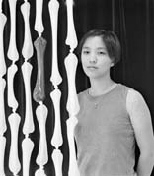
Those who pass through the second-floor intersection of Buildings 8, 16 and 26 may have noticed a new addition to the space: a temporary installation of hand blown glass bones created by Helen Lee (SB 2000, architecture).
Strung together and hung side by side, the curtain of bones, entitled Blanket, was created by Ms. Lee in MIT's Glass Lab, where she began taking classes her freshman year. This is the first time she's had the opportunity to address her interests in spatial experiences and scale through an installation of blown glass.
The installation is in part "about my family life and parts of my self that are not immediately related to my experiences at MIT," said Ms. Lee, winner of a 1999 List Foundation Fellowship in the Arts."Blanket came out of my thoughts on my grandmother and her passing, my Chinese name and identity, the ancestor that chose my generational name, my newborn niece, and all the gestures of hope that have been put forth by my family and every family," she said.
The installation is on view through May 20. For more information, call x3-8089.
A version of this article appeared in MIT Tech Talk on May 16, 2001.