The Freshman Advising Seminar Program is looking for instructors to lead next fall's Freshman Advising Seminars -- and MIT will offera financial as well as personal incentive to do so.
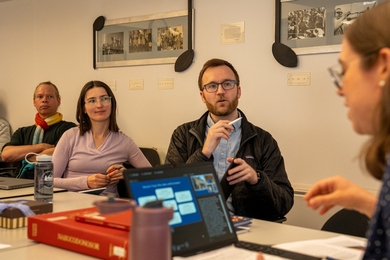
Every year, 800-900 freshmen are accommodated in eight-person seminars taught by faculty and research staff who volunteer their time and are assisted by upperclass associate advisors. So far, 80 volunteers have come forward for next year's program, leaving a shortfall of about 45 instructors. Staff in the Academic Resource Center are working to fill this gap, but concerns remain that not enough seminars will be mustered to meet the demand.
President Charles Vest and Provost Joel Moses have offered a $1,500 scholarly allowance to faculty and research staff who lead Freshman Advising Seminars to encourage more volunteers to come forward. Any faculty or research staff member who is interested in leading a seminar should contact Donna Friedman at the Academic Resource Center, Rm 7-104, x3-6771, friedman@mit.edu.
The Freshman Advising Seminar Program has proven extremely popular with MIT students since its inception under the leadership of Professor Emeritus Travis Merritt in 1986. Last fall, freshmen were able to choose from seminars offering activities such as building an electric go-kart, using computers to model the biology and physics of the sea, field-testing golf and ski equipment, and inventing and building new "Things That Think." Other seminars dealt with the study and writing of poems, "Genes in the News," and "Conflict and Peace in the Contemporary Middle East."
A version of this article appeared in MIT Tech Talk on April 1, 1998.