Two groups of students in a graduate engineering class are designing sensors that will help middle-school children in Rhode Island learn about science and technology by assembling Lego robots in school.
The MIT students' work is in aid of the Rhode Island Robotics Design Project (RIRDP). As their term projects for 2.870, Total Quality Development, two groups comprising about a third of the class have been working on developing sensors for the robots. MIT's link to the Rhode Island initiative is Thomas Kowalczyk, a 1969 MIT graduate who now works for the Navy in Newport, RI. Mr. Kowalczyk, who took 2.870 himself in 1991, is involved with grade-school technology education efforts in his area on a volunteer basis. He also helped adapt elements of the School of the Future, a methodology for hands-on science teaching developed at MIT's Media Lab in the 1980s, for use in Rhode Island.
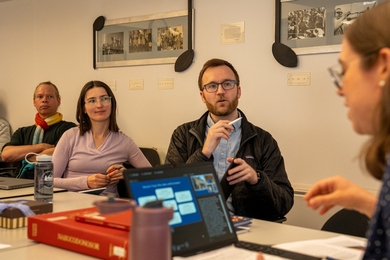
The MIT class, which is taught by Don Clausing, Bernard M. Gordon Adjunct Professor of Engineering Innovation and Practice, teaches students how to develop new products by starting with the "voice of the customer." Accordingly, 12 of the MIT students visited a middle school in Peacedale, RI, and talked with children and teachers to find out what they wanted for their robots. As a result of those conversations, they returned to MIT with plans to develop a sensor that could detect and react to three different colors and another that could react to sounds. The sensors will be incorporated into robots that the children will design and build, then program to perform various simple behaviors.
Studies have shown that some children, particularly girls and minorities, lose interest in science starting around fourth grade, Mr. Kowalczyk said. RIRDP participants hope that working with Lego robots and other tools that require active, creative problem-solving will encourage them to pursue science and technology.
"If you make something fun and interesting, they'll get involved with it. But the first thing is to generate interest," Professor Clausing said.
The work done by the sound sensor group involved selecting and testing a microphone with the proper sensitivity and directional responsiveness that could also be mounted on a moving Lego platform. Another requirement was rugged construction; "it has to be used by a lot of kids over several years," noted team member Audrey Dima, a graduate student in the Leaders for Manufacturing program. Other members of the team are Roberta Bailey of electrical engineering and computer science, Eugene Hamacher and William Householder of the LFM, and Todd Stout and Constantinos Boussios of mechanical engineering.
Students working on the color sensor selected photoresistors and filters in a design for a device that will detect red, green and blue backgrounds. By programming robots to act on this information, children will learn something about what color is and how it can be electro-optically sensed. Team members are Mark Maclean of LFM and Ali Alagheband, Rajesh Bilimoria, Craig Weidner, Tolga Ozgen and Ahmet Ashaboglu of mechanical engineering.
This is the third year that part of Professor Clausing's class has done projects for the RIRDP. Past projects included creating plans for a "technical playground" with simple, large-scale mechanical devices that children could operate.
A version of this article appeared in the December 7, 1994 issue of MIT Tech Talk (Volume 39, Number 14).