In 2024, a U.S. government official warned that Russia could be developing a new satellite designed to carry nuclear weapons into space. The statement followed the launch of a suspicious Russian satellite into low-Earth orbit in 2022, just a few weeks before the country’s full-scale invasion of Ukraine.
A nuclear detonation in low-Earth orbit — the region about 100 miles to 1,200 miles above Earth’s surface — would release trillions of highly energetic electrons that would destroy many of the satellites in space, disrupting telecommunications networks, GPS, space-based internet, and more.
The 1967 Outer Space Treaty bans the placement of nuclear weapons in space, but there’s currently no way to verify satellites don’t contain nuclear weapons. In fact, no verification methods have even been proposed in unclassified, peer-reviewed literature.
Now, MIT Professor Areg Danagoulian is proposing a way to determine if a satellite orbiting Earth contains a nuclear weapon. In a new paper published in Nature, Danagoulian describes his idea for a satellite-based sensor system that could orbit close by a suspect satellite and detect neutrons generated by high-energy protons colliding with radioactive material.
In the paper, Danagoulian calculates that a sensor system the size of a large encyclopedia could detect a nuclear weapon with 99 percent accuracy if it orbited within 4,000 meters of the suspect satellite for about a week. He also estimates that the detection time could be cut to a matter of hours if multiple satellite sensors were used or the sensor satellite was able to get within 1,000 meters of the suspect satellite.
“If we eventually have some verification mechanisms for the Outer Space Treaty, that will put pressure on countries to respect the treaty or disclose what they are doing, because they know if they try to violate it, we will find out,” Danagoulian says. “I very much hope this will turn into a real system, or proof-of-concept system, but the goal right now is to get national labs to use this work for their own research, and to get policymakers to seriously consider this technology as a potential part of national technical means.”
Protecting space
In 1962, the U.S. detonated a 1.4-megaton thermonuclear warhead in space, which unintentionally destroyed many of the early satellites of the era. The blast released enormous volumes of highly energized electrons, and many became trapped in Earth’s magnetic field, where they damage any electronics in their path.
“When you have a nuclear detonation in outer space, basically the whole body of the bomb becomes ionized, and nearly every single electron in the weapon’s mass becomes free,” Danagoulian explains. “It gets injected into what’s called the inner Van Allen radiation belt. Once there, the electrons start hitting everything flying through those belts, causing ionization, radiation damage, and more. As you go further out into space, you create these thick belts around Earth populated by highly energetic protons and electrons.”
The 1967 Outer Space Treaty declared space the “province of all mankind” and banned nuclear weapons in space, among other safeguards. It has since been signed by 118 countries including the U.S., China, and Russia.
Monitoring compliance with the treaty has taken on increased urgency since Russia’s 2022 launch of a suspicious satellite, Cosmos2553, which Russia claims is used for surveillance and sensing. However, U.S. authorities believe it may carry components of a nuclear device undergoing testing, with the possible future goal of fielding an actual nuclear anti-satellite weapon. The detonation of a nuclear weapon at that orbit could destroy many of the U.S. reconnaissance satellites, international communication satellite platforms, as well as the Starlink satellites.
“The Russians launched this satellite in a very strange and unusual orbit because it goes through the most hostile environment possible around the planet,” Danagoulian explains. “No one puts satellites there because it’s highly radioactive. Why would you put a satellite in that orbit? Well, that location is likely the best point for trapping electrons if you were to detonate a thermonuclear weapon.”
Danagoulian notes most research on nuclear detection is highly classified, making it hard to know how much progress has been made in national labs. But he wanted to show that scientifically proving the presence of a nuclear weapon in space is possible.
Particle bombardment
The approach Danagoulian developed centers on a reaction known as spallation, caused by highly energetic protons in radioactive environments.
“When an energetic proton slams into elements with a high atomic number, like uranium and plutonium, each proton may knock out something like 40 neutrons,” he explains. “That’s a ridiculously large number. We’re talking about millions of protons per second per square centimeter, with many of them generating 40 neutrons. The question is can you detect some of those neutrons?”
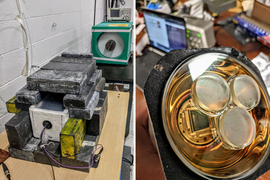
Normal satellites wouldn’t emit nearly as many neutrons, but there are still naturally occurring protons, neutrons, and electrons in the atmosphere, especially in low-Earth orbit. Danagoulian’s concept uses two panels made up of pixels of neutron sensors known as scintillators that interact with radiation and emit light. The panels are sandwiched between synthetic crystal diamond detectors that allow the system to distinguish between neutrons coming from radioactive materials and natural protons and electrons. The two-panel construction then can be used to estimate the direction of the neutron, allowing it to differentiate between natural atmospheric neutrons and those coming from a suspected satellite.
“Most neutron detectors are very sensitive to protons, so you have to come up with some smart ways to reject protons but keep neutrons,” Danagoulian says. “You also have to tell the difference between naturally occurring neutrons and neutron spallation from the satellite.”
He believes the system, placed inside of an inspector satellite, would be strong enough to survive the harsh environment of low-Earth orbit while also being fast enough to process the protons, electrons, and neutrons that bombard it.
Danagoulian’s calculations on how long the detector satellite would have to be near the suspect satellite give him confidence in the feasibility of the system. If a detector satellite were able to get within 1,000 meters of the suspect satellite, it could accurately detect nuclear weapons in about one hour. That would amount to a single flyby.
Danagoulian calls the paper a feasibility study of the concept.
“I say in the paper this isn’t a completely proven system,” he says. “The purpose of the paper is to show the scientific community that it’s scientifically possible to do this. But there are many more practical considerations to be made to actually build these detectors.”
Danagoulian hopes the study will stimulate further research and development. He is also working with researchers in MIT’s Center for Nuclear Security and Policy (CNSP) to understand the policy landscape around this issue.
If a version of his system is eventually developed, Danagoulian believes it could encourage the nonproliferation that has helped preserve satellites so far. He notes that while adversarial countries are naturally suspicious of each other’s claims, scientific evidence would strengthen trust.
“You can fake intelligence,” he says, “but you can’t fake physics.”
The work was supported, in part, by the National Nuclear Security Administration, the Carnegie Foundation, and Longview Philanthropy.