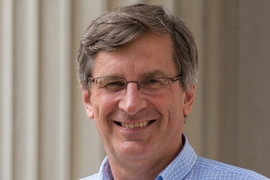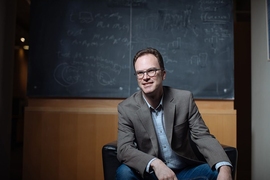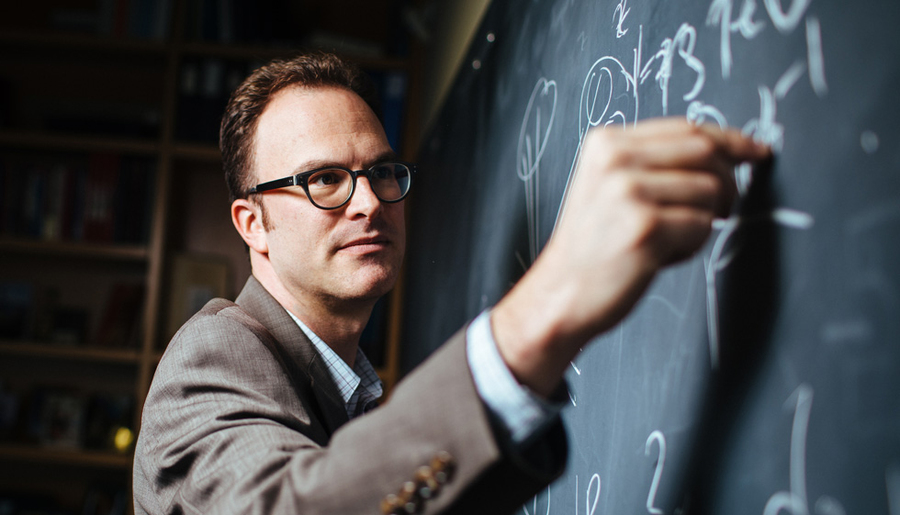
Professor Jesse Thaler has been named director of the MIT Laboratory for Nuclear Science (LNS), effective Aug. 1. He succeeds Professor Bolek Wyslouch, who directed LNS for the past decade. Thaler is a theoretical particle physicist who combines techniques from quantum field theory and machine learning to address outstanding questions in fundamental physics.
“In his research, Jesse has done pioneering work on particle jets at the Large Hadronic Collider and is a leader in combining AI and machine learning with fundamental particle physics,” says Nergis Mavalvala, dean of the MIT School of Science and the Curtis and Kathleen Marble Professor of Astrophysics. “The collaborative nature of his research programs will serve the Laboratory for Nuclear Science as science enters a new era of AI-driven discovery.”
Thaler is the William and Emma Rogers Professor of Physics in the MIT Center for Theoretical Physics — a Leinweber Institute (CTP-LI). Since 2020, he has served as inaugural director of the National Science Foundation (NSF) AI Institute for Artificial Intelligence and Fundamental Interactions, or IAIFI, which was recently renewed for another five years. Mike Williams, professor of physics, will succeed Thaler as IAIFI director. LNS is also poised to pursue new research projects through the Department of Energy’s Genesis Mission, which has a focus on AI-enabled scientific discovery.
“In my own field of particle physics, researchers are developing cutting-edge AI algorithms to handle the data deluge from collider experiments and to perform heroic theoretical calculations. This work has direct implications for discovering new physics, but the algorithms themselves turn out to be valuable well beyond our field,” says Thaler. “I’m excited to bring LNS into the next wave of discoveries supported by AI-driven capabilities.”
At IAIFI, Thaler has championed education and research activities at the intersection of physics and AI. With the MIT Institute for Data, Systems, and Society, IAIFI leadership created a doctoral program in physics, statistics, and data science. IAIFI also created dedicated postdoctoral fellowships to give early-career researchers the freedom to pursue interdisciplinary work.
“Giving young scientists space to build connections across domains, universities, and career stages has been transformative within IAIFI,” says Thaler, who hopes to bring this type of framework to LNS. Established in 1946 to support nuclear and particle physics, LNS now encompasses research spanning cosmology, gravity, field theory, and quantum information science.
As head of LNS, Thaler will also oversee his home center of CTP-LI, which last year received a donation from the Leinweber Foundation to establish a network of theoretical physics research institutes. According to the Science Philanthropy Alliance, a nonprofit organization that promotes philanthropy for science, this constitutes the largest philanthropic commitment ever for this field.
Thaler received his PhD in physics from Harvard University in 2006, and his BS in math/physics from Brown University in 2002. From 2006 to 2009, he was a fellow at the Miller Institute for Basic Research in Science at the University of California at Berkeley. He joined the MIT faculty in 2010.