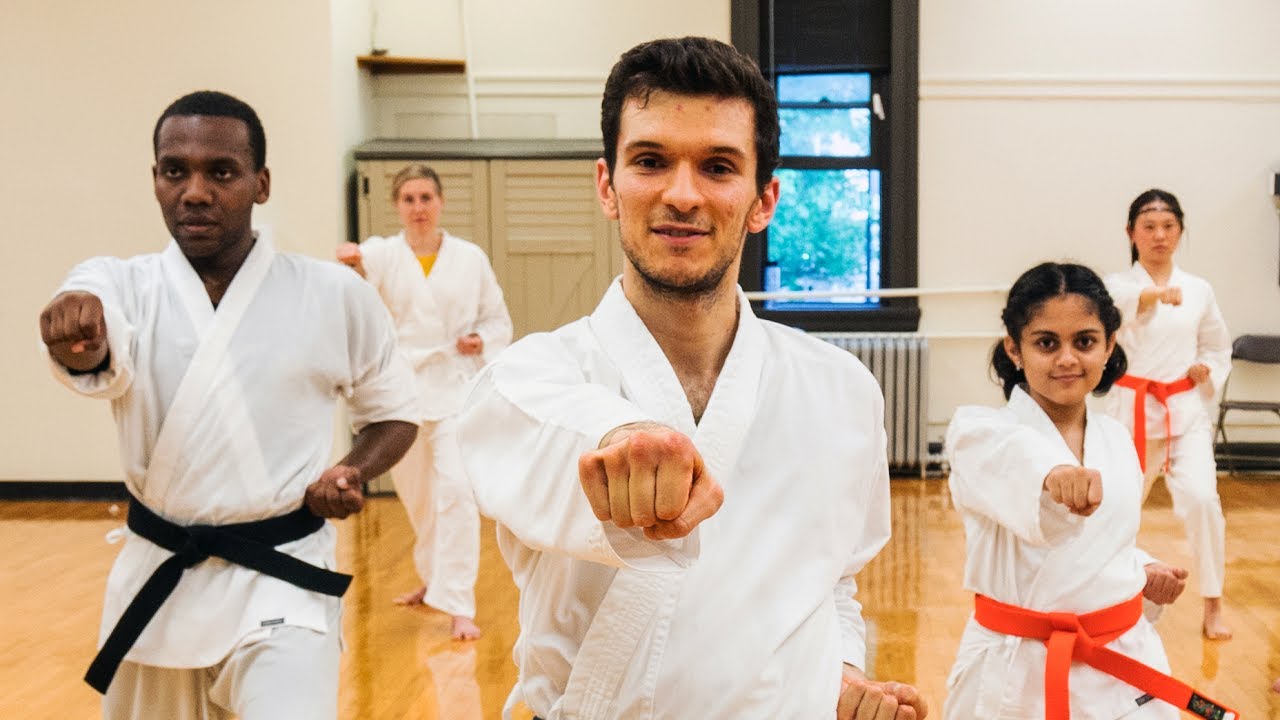
Vazrik Chiloyan, an instructor for the MIT Shotokan Karate Club, developed a love for karate nearly a decade ago. Since then, Chiloyan, a graduate student in mechanical engineering, has earned a second-degree black belt. Shotokan karate, he says, is one of the most beautiful things he has ever studied.
"Karate, for me, is the most introspective art," Chiloyan says. "You have to perfect your whole being for one motion. That unification is very, very satisfying."
Founded in 1974 by Sensei Kazumi Tabata, the MIT Shotokan Club is a member New England Collegiate Karate Conference. The club competes with Boston University, Cornell University, Harvard University, Tufts University, University of Connecticut, University of Massachusetts at Dartmouth, and the University of Toronto.
From beginners to individuals with experience in other styles, the club welcomes members from all corners of the MIT community. Right now, Chiloyan and his fellow karate enthusiasts are gearing up for a November tournament at the Tokyo Institute of Technology.
Submitted by: School of Engineering | Video by: Lillie Paquette | 1 min, 46 sec