
What number is halfway between 1 and 9? Is it 5 — or 3?
A new information-theoretical model of human sensory perception and memory sheds light on some peculiarities of the nervous system.
A new information-theoretical model of human sensory perception and memory sheds light on some peculiarities of the nervous system.
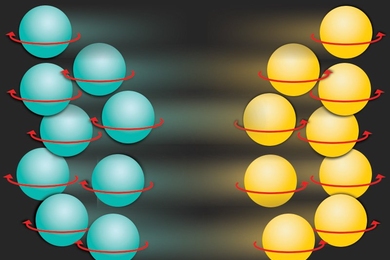
Work correlating ultracold atoms’ spin with their direction of motion may help physicists model new circuit devices and unusual phases of matter.
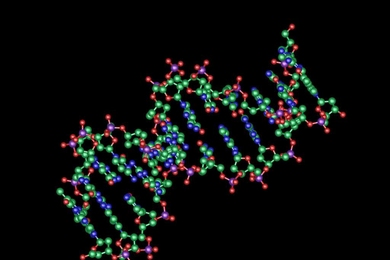
Engineers design new proteins that can help control novel genetic circuits in cells.

Long-sought goal for quantum devices — the ability to transmit single photons while blocking multiple photons — is finally achieved.

Jarillo-Herrero, Lu, Pathak, Sinha and Thaler among 96 winners.
New technologies from Marin Soljacic’s lab could have a far-reaching impact on daily life.

A fiber that can emit light along its length in any direction may herald flexible 3-D displays and medical tools that activate therapeutic compounds with bursts of light.
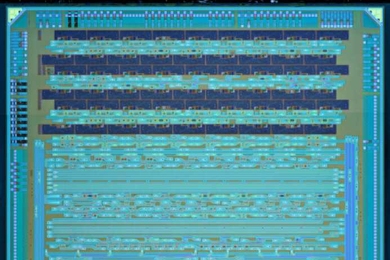
To keep energy consumption under control, future chips may need to move data using light instead of electricity — and the technical expertise to build them may reside in the United States.

Clever math could enable a high-quality 3-D camera so simple, cheap and power-efficient that it could be incorporated into handheld devices.
Project Angstrom selected by magazine's editors; featured in December issue

Researcher led a career distinguished by abundant accomplishments, widespread impact in his 55 years at MIT.
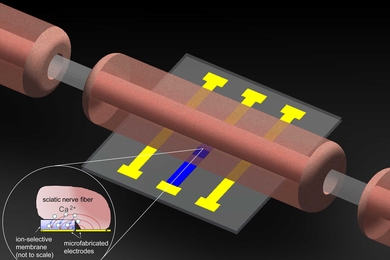
Researchers improve the efficiency of devices that stimulate damaged nerves, reducing potential side effects.
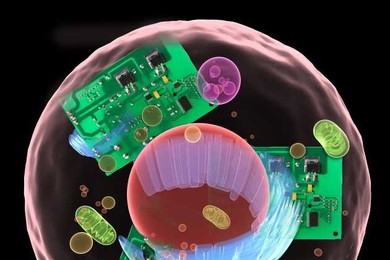
Analog — rather than digital — circuits could enable models of biological systems that are more efficient, more accurate and easier to build.
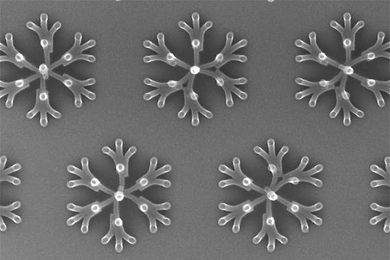
By turning a common problem in chip manufacture into an advantage, MIT researchers produce structures only 30 atoms wide.