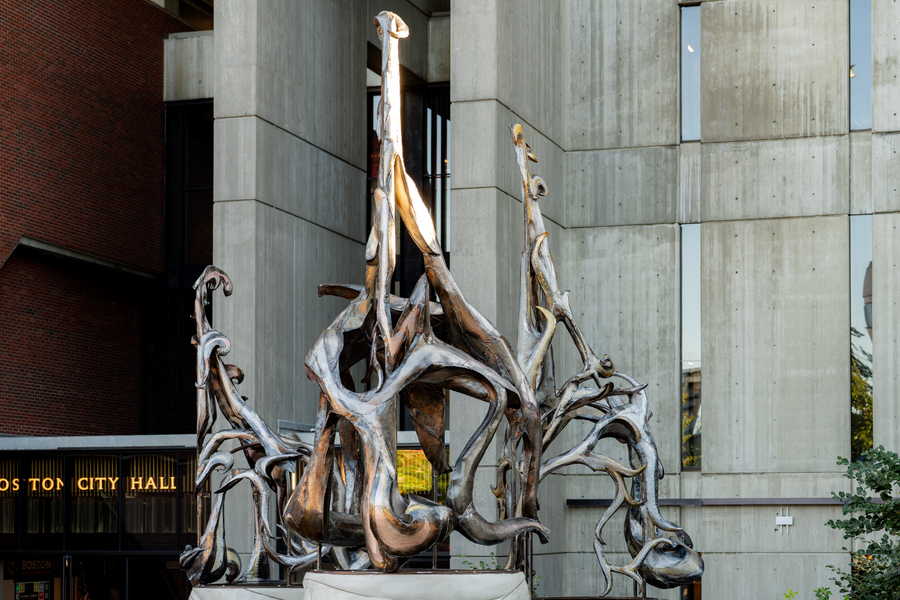
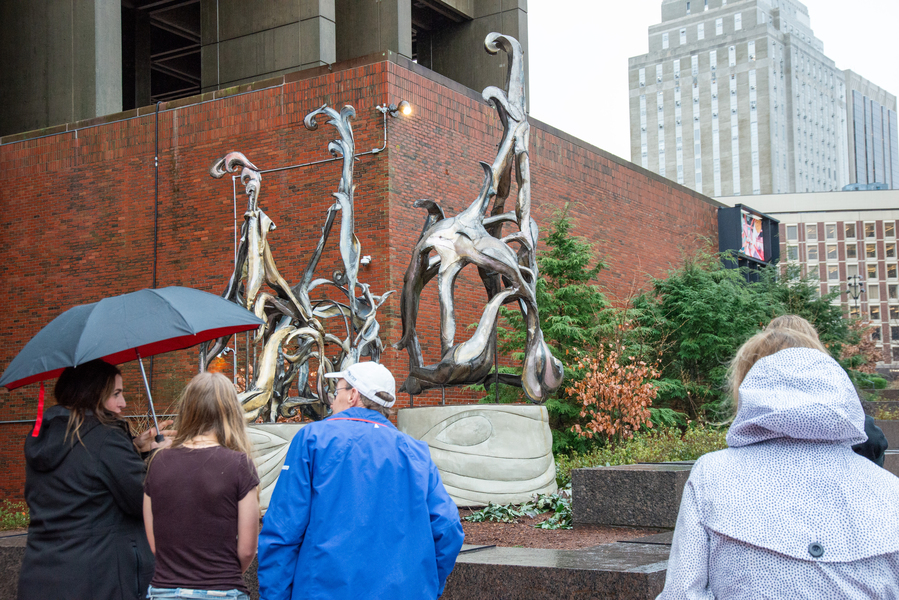
Boston recently got its own good luck charm, “Amulet,” a 19-foot-tall tangle of organic spires installed in City Hall Plaza and embedded with the wishes, hopes, and prayers of residents from across the city.
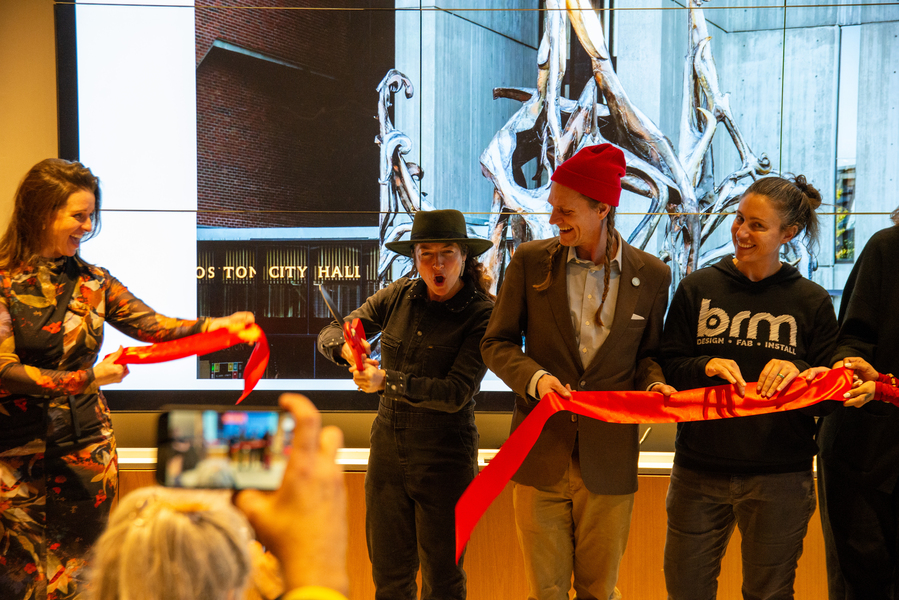
The public artwork, by artist Rhea Vedro — also a lecturer and metals artist-in-residence in MIT’s Department of Materials Science and Engineering (DMSE) — was installed on the north side of City Hall, in a newly renovated stretch of the plaza along Congress Street, in October and dedicated with a ribbon cutting on Dec. 19.
“I’m really interested in this idea of protective objects worn on the skin by humans across cultures, across time,” said Vedro at the event in the Civic Pavilion, across the plaza from the sculpture. “And then, how do you take those ideas off the body and turn them into a blown-up version — a stand-in for the body?”
Vedro started exploring that question in 2021, when she was awarded a Boston Triennial Public Art Accelerator fellowship and later commissioned by the city to create the piece — the first artwork installed in the refurbished section of the plaza. She invited people to workshops and community centers to create hundreds of “wishmarks” — steel panels with hammered indentations and words, each representing a personal wish or reflection.
The plates were later used to form the metal skin of the sculpture — three bird-like forms designed to be, in Vedro’s words, a “protective amulet for the landscape.”
“I didn’t ask anyone to share what their actual wishes were, but I met people going into surgery, people who were homeless and looking for housing, people who had just lost a loved one, people dealing with immigration issues,” Vedro said. She asked participants to meditate on the idea of a journey and safe passage. “That could be a literal journey with ideas around immigration and migration,” she said, “or it could be your own internal journey.”
Large-scale art, fine-scale detail
Vedro, who has several public artworks to her name, said in a video about making “Amulet” that the project was “the biggest thing I’ve ever done.” While artworks of this scale are often handed off to fabrication teams, she handled the construction herself, starting on her driveway until zoning rules forced her to move to her father-in-law’s warehouse. Sections were also welded at Artisans Asylum, a community workshop in Boston, where she was an artist in residence, and then moved to a large industrial studio in Rhode Island.
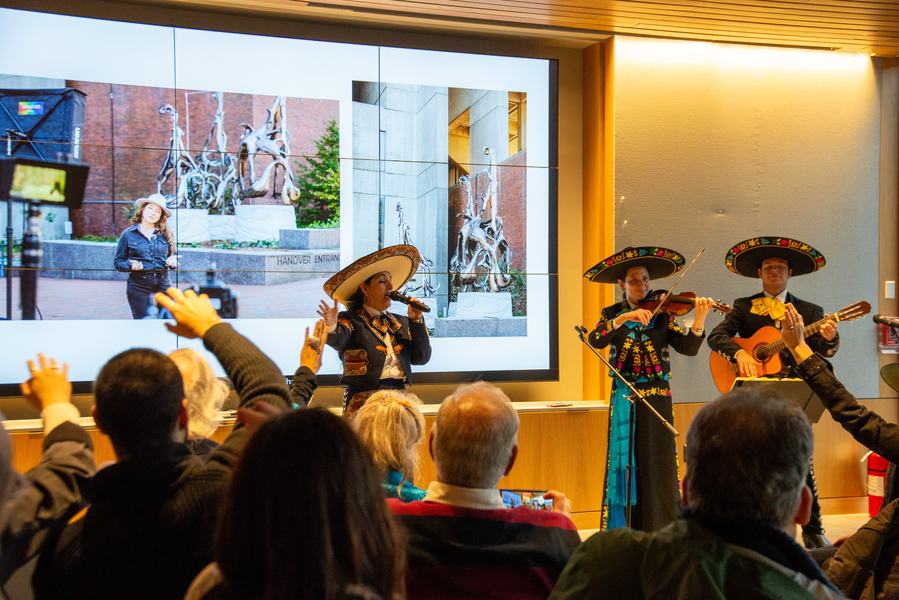
At the ribbon-cutting event, Vedro thanked friends, family members, and city officials who helped bring the project to life. The celebration ended with a concert by musician Veronica Robles and her mariachi band. Robles runs the Veronica Robles Cultural Center in East Boston, which served as the main site for wishmark workshops. The sculpture is expected to remain in City Hall Plaza for up to five years.
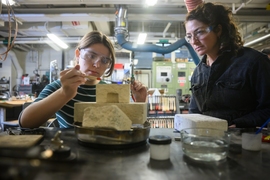
Vedro’s background is in fine arts metalsmithing, a discipline that involves shaping and manipulating metals like silver, gold, and copper through forging, casting, and soldering. She began working at a very different scale, making jewelry, and then later moved primarily to welded steel sculpture — both techniques she now teaches at MIT. When working with steel, Vedro applies the same sensitivity a jeweler brings to small objects, paying close attention to small undulations and surface texture.
She loves working with steel, Vedro says — “shaping and forming and texturing and fighting with it” — because it allows her to engage physically with the material, with her hands involved in every millimeter.
The sculpture’s fluid design began with loose, free-form bird drawings on a cement floor and rubber panels with soapstone, oil pastels, and paint sticks. Vedro then built the forms in metal, welding three-dimensional armatures from round steel bars. The organic shapes and flourishes emerged through a responsive, intuitive process.
“I’m someone who works in real-time, changing my mind and responding to the material,” Vedro says. She likens her process to making a patchwork quilt of steel pieces: forming patterns in a shapeable material like tar paper, transferring them to steel sheets, cutting and shaping and texturing the pieces, and welding them together. “So I can get lots of curvatures that way that are not at all modular.”
From steel plates to soaring form
The sculpture’s outer skin is made from thin, 20-gauge mild steel — a low-carbon steel that’s relatively soft and easy to work with — used for the wishmarks. Those plates were fitted over an internal armature constructed from heavier structural steel.
Because there were more wishmark panels than surface area, Vedro slipped some of them into the hollow space inside the sculpture before welding the piece closed. She compares them to treasures in a locket, “loose, rattling around, which freaked out the team when they were installing.” Any written text on the panels was burned off when the pieces were welded together.
“I believe the stuff’s all alchemized up into smoke, which to me is wonderful because it traverses realms just like a bird,” she says.
The surface of the sculpture is coated with a sealant — necessary because the outer skin material is prone to rust — along with spray paints, patinas, and accents including gold leaf. Its appearance will change over time, something Vedro embraces.
“The idea of transformation is actually integral to my work,” she says.
Standing outside the warmth of the Civic Pavilion on a windy, rainy day, artist Matt Bajor described the sculpture as “gorgeous,” attributing its impact in part to Vedro’s fluency in working across vastly different scales.
“The attention to detail — paying attention to the smaller things so that as it comes together as a whole, you have that fineness throughout the whole sculpture,” he said. “To do that at such a large scale is just crazy. It takes a lot of skill, a lot of effort, and a lot of time.”
Suveena Sreenilayam, a DMSE graduate student who has worked closely with Vedro, said her understanding of the relationship between art and craft brings a unique dimension to her work.
“Metal is hard to work with — and to build that on such small and large scales indicates real versatility,” Sreenilayam said. “To make something so artistic at this scale reflects her physical talent, and also her eye for detail and expression.”
Bajor said “Amulet” is a striking addition to the plaza, where the clean lines of City Hall’s Brutalist architecture contrast with the sculpture’s sinuous curves — and to Boston itself.
“I’m looking forward to seeing it in different conditions — in snow and bright sun — as the metal changes over time and as the patina develops,” he said. “It’s just a really great addition to the city.”