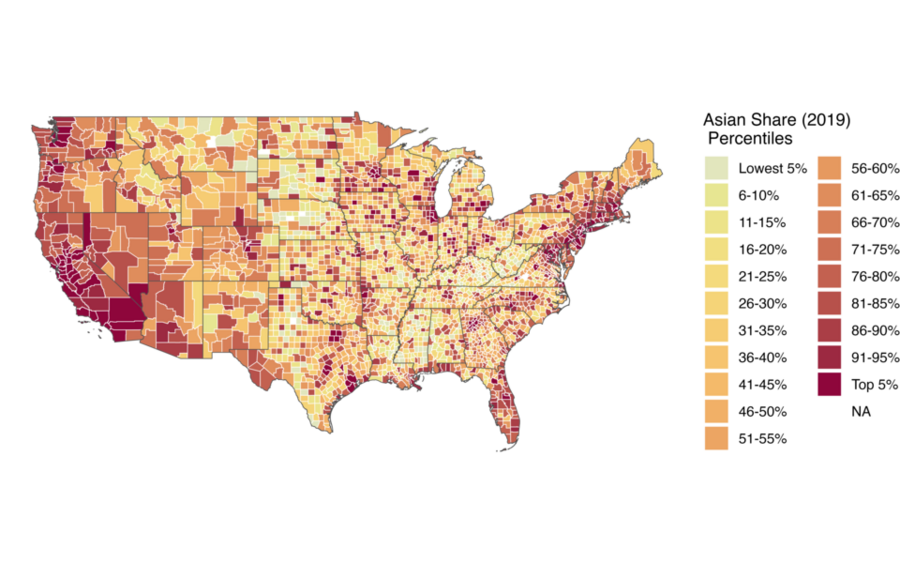
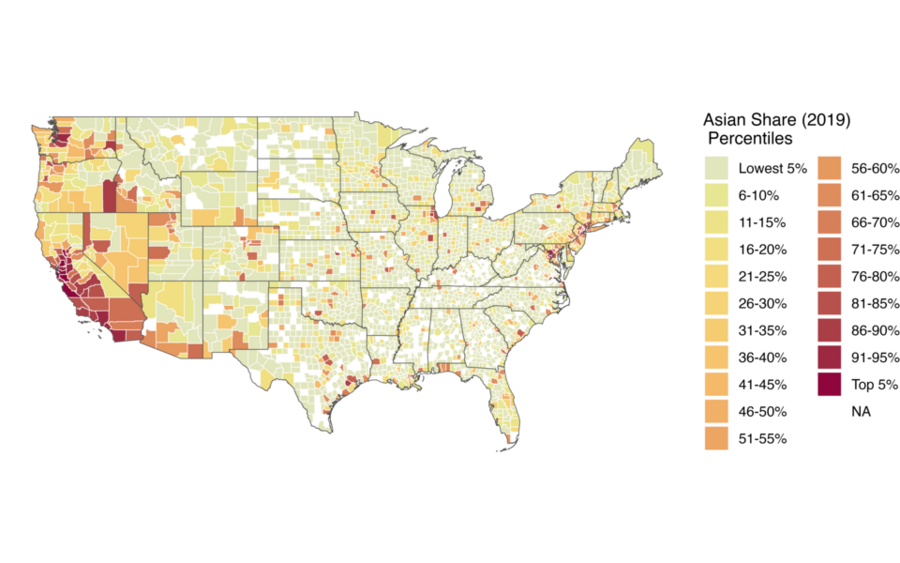
Asian immigrants are both the fastest-growing and highest-earning immigrant ethnic group in the United States, facts that have caught the attention of many economists interested in how these groups — whether investors or residents — impact housing prices, K-12 education, and other important aspects of community life.
A new study by economists at MIT and the University of Cincinnati delves into this trend, focusing on the potential mechanisms at work behind the correlation of rising home prices and subsequent improvements in education at the county level. Their findings suggest that home prices rise not simply due to increased demand, but because the new neighbors have a positive influence on the quality of K-12 education, which in turn increases desirability.
The study focuses on 2008 to 2019, a period that saw a relative spike in US immigration from six Asian countries in particular — China, India, Japan, Korea, the Philippines, and Vietnam. Among this group, the economists focused specifically on those who arrived on non-permanent visas for study or work — a cohort that represents a distinct and growing channel of new immigrant inflow, and is often pre-selected by universities and employers.
“We’re looking at a window when the influx of Asian immigrants has a particularly strong preference for education, and who themselves were also highly educated,” says Eunjee Kwon, the West Shell, Jr. Assistant Professor of Real Estate in the Department of Finance at the University of Cincinnati, a co-author on the study published in the May issue of the Journal of Urban Economics. “This period also marks a notable shift in the socioeconomic profile of Asian immigrants to the U.S., with this cohort arriving with higher levels of education and income relative to earlier waves of Asian immigrants and, in many cases, relative to the native-born population.”
While county data is not granulated to the neighborhood or even municipality level, the researchers found that 30 to 40 percent of the rise in home values purchased in areas where Asian immigrant buyers have school-age children correlates with improved quality of education, as indicated by the average rise in standardized test scores of all children in the county.
“Maybe some Asian buyers are pure investors, but many of them become residents who buy homes for themselves and their families, and transform the neighborhoods,” says co-author Siqi Zheng, the Samuel Tak Lee Professor of Urban and Real Estate Sustainability at the MIT Center for Real Estate and the Department of Urban Studies and Planning. “We show that this is not negligible; it is a big component. We can attribute at least one-third of housing price increases to improved education.”
Amanda Ang, a postdoc in the Department of Economics at Aalto University in Helsinki, is the third co-author of the paper. The work is somewhat personal for the scientists, who undertook the study without funding in order to see for themselves what impact this particular group of immigrants had on neighborhoods.
“We wanted to understand what this group contributes to the communities where they settle," Kwon says. “We found that their presence benefits children of all other backgrounds, too."
Ang, Kwon, and Zheng use an econometric approach called an instrumental variable to home in on a causal correlation, and not just an association. To help ensure accuracy, they carefully omitted counties that have long been home to large Asian communities — such as San Francisco, Los Angeles, and New York — in order to capture the impact of recent immigrants on other counties.
“I believe that this will be a highly influential paper because it asks a very important question and uses credible statistical methods to try to disentangle selection effects from treatment effects, using a subtle analysis accounting for displacement,” says Matthew Kahn, the Provost Professor of Economics and Spatial Sciences at the University of Southern California, who was not involved with the research.
“What really interests me about this paper is that it suggests that there can be a positive spillover effect: that U.S. areas that attract Asian immigrants also gain from improved school quality,” Kahn says. “It’s the first I’ve seen undertaken on this very important hypothesis, which certainly merits additional future research, possibly using school-level and individual-level data.”