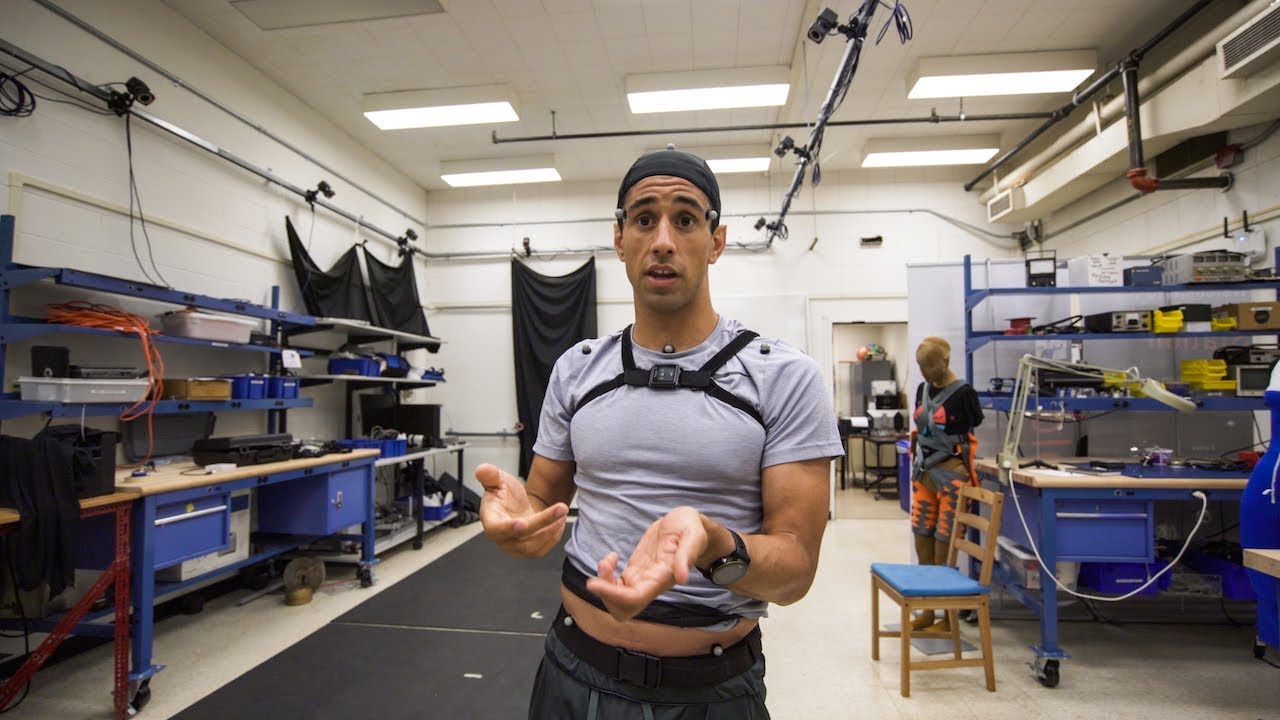
Movement really moves Richard Fineman, a fourth-year PhD student in the Harvard-MIT Program in Health Sciences and Technology. Using wearable sensors and a range of complex modeling tools, Fineman is able to measure and understand a body in motion in unprecedented ways. He is using what he’s learning to advance human health and medicine, as well as astronaut garb.
As a lifelong athlete, Fineman has always been interested in biomechanics and human motion. In his work, he is “able to evaluate whether a patient is at risk for falling” by using cameras and computers to gather position and movement data. Subjects in the lab are fitted with wearable sensors and asked to complete certain tasks. Their movements are tracked and captured and the resulting data is processed and analyzed to help define models that can “determine whether or not someone is at high versus low fall risk,” he explains.
Fineman’s work measuring movement here on Earth piqued his curiosity about human bodies in motion in other environments. “How does human motion change in altered gravity environments?” he asks. “I think about how spacesuits are these big bulky objects. … Each suit has to be fit to the human, but we don’t really have objective ways to determine how well the suit fits.”
Luckily, Fineman is a member of Assistant Professor Leia Stirling's group in the Department of Aeronautics and Astronautics, where he was able to step into a space suit himself to experiment. Using his wearable sensors, Fineman was able to come up with techniques to evaluate and improve the way the space suit fits on the human.
Submitted by: Carolyn Blais | Video by: Lillie Paquette | 2 min, 11 sec